






Despite the growing acceptance of qualitative research across the social, behavioral, and health sciences, relatively little attention has been given to how the specific choice of methodological approach shapes every phase of a study — from the framing of research questions to data collection, analysis, and final representation.
 Curated by Business Science Daily — peer-reviewed sources, human-verified.
Learn more
Curated by Business Science Daily — peer-reviewed sources, human-verified.
Learn more
About Our Curation Process
Business Science Daily curates academic research in business and economics. Each featured study is selected from reputable, peer-reviewed journals, institutional repositories, or working papers (e.g., Elsevier, Sage, NBER, SSRN).
Articles are carefully summarized to ensure clarity and accuracy, with direct citations or links to original sources. Our process emphasizes transparency, academic integrity, and accessibility for a broader audience.
Learn more in our Editorial Standards & AI Policy.
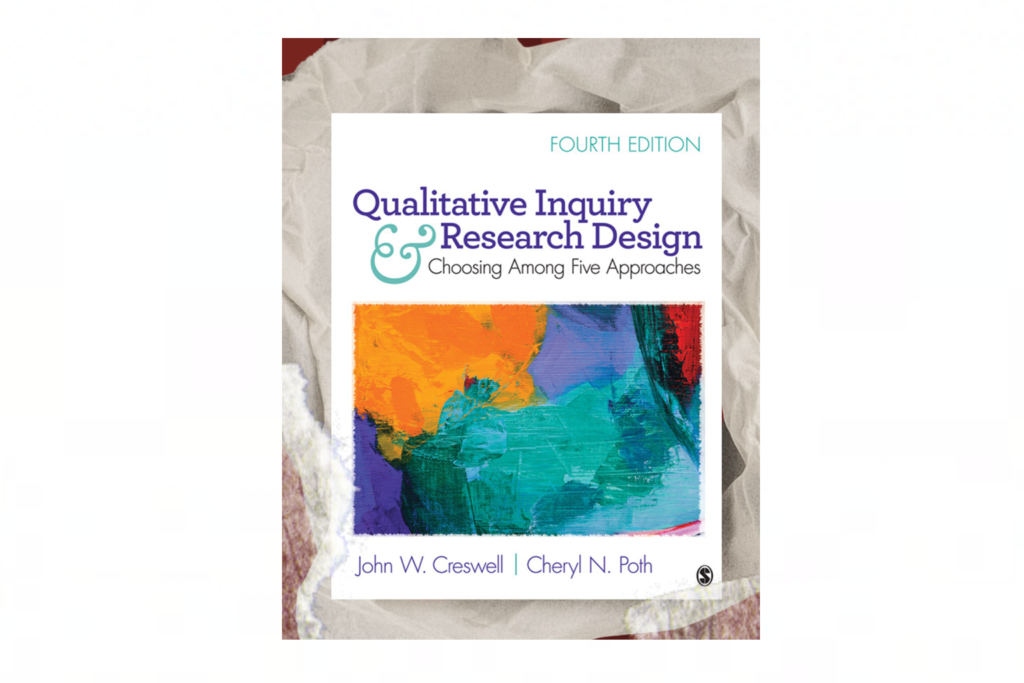
Creswell and Poth’s fourth edition, published by SAGE in 2018, systematically compares five established approaches to qualitative inquiry: narrative research, phenomenology, grounded theory, ethnography, and case study.
Rather than advocating for a single “correct” method, the book places the five approaches side by side, tracing how each informs the research process from the initial problem statement through data collection, coding, writing, and validation.
The book synthesizes key primary sources for each tradition — Clandinin for narrative, Moustakas and van Manen for phenomenology, Charmaz and Corbin & Strauss for grounded theory, Wolcott and Fetterman for ethnography, and Stake and Yin for case study — and includes, in the appendices, a full-length published journal article for each.
What distinguishes the five approaches?
Each approach answers a different kind of research question.
Narrative research examines the lived and told stories of one or two individuals, often emphasizing chronology and turning points.
Phenomenology seeks the common essence of a phenomenon — such as grief or waiting for a transplant — across five to twenty-five participants.
Grounded theory moves beyond description to generate a substantive theory of a process or action, grounded in participant data.
Ethnography describes and interprets the shared patterns of behavior, language, and beliefs of an intact, culture-sharing group over the course of extended fieldwork.
A case study provides an in-depth analysis of a bounded system — a single program, event, individual, or organization — using multiple sources of evidence.
What the book provides
Across eleven chapters and six appendices, the book covers philosophical assumptions (ontology, epistemology, axiology, methodology), interpretive frameworks (postpositivism, social constructivism, transformative, pragmatism, feminist, critical race, queer, disability theories), and practical design elements such as purposeful sampling, data collection protocols, coding strategies, and validation procedures, including triangulation and member checking.
The final chapter demonstrates how the same research problem — a campus response to a gunman incident — can be redesigned as a narrative biography, a phenomenology, a grounded theory study, an ethnography, and a case study, illustrating that methodology is not an afterthought but a foundational choice that structures every subsequent decision.
Scale and scope: A single researcher conducting a grounded theory study might interview twenty to thirty participants over six to twelve months. An ethnographer might spend one to two years in the field. Across thousands of graduate theses, dissertations, and peer-reviewed articles published annually, the cumulative effect of these methodological choices shapes how the social sciences understand human experience — from patient perspectives on chronic illness to teacher-student relationships in at-risk schools, from identity formation among immigrant youth to organizational responses to crisis.
Designing qualitative research
Qualitative research begins with assumptions and interpretive/theoretical frameworks that inform the study of research problems addressing the meaning individuals or groups ascribe to a social or human problem. Characteristics: natural setting, researcher as key instrument, multiple sources, inductive‑deductive logic, participants’ meanings, emergent design, reflexivity, holistic account (Creswell & Poth, 2018, pp. 43–45).
Interpretive frameworks (Chapter 2)
Postpositivism, social constructivism, transformative frameworks (action agenda), postmodern, pragmatism, feminist theories, critical race theory, queer theory, disability theories. Each shapes research goals, power relations, and the call for change (pp. 23–36).
When to use qualitative research?
- Need to explore a problem, give voice to silenced populations.
- Complex, detailed understanding is required (not just variables).
- Follow up quantitative results to understand processes and context.
- Develop theories when existing theories are inadequate.
Ethical issues span all phases: IRB approval, informed consent, reciprocity, power imbalances, anonymity, member checking (pp. 54–58).
The five approaches share the general research process but differ in focus: exploring a life (narrative), understanding essence of experience (phenomenology), generating a theory (grounded theory), describing a culture‑sharing group (ethnography), in‑depth case analysis (case study).
Narrative research — stories of lived experience
Narrative research studies the lived and told stories of individuals, often a single person. It emphasizes chronology, collaboration, and exploring social/cultural/institutional narratives. Data: interviews, documents, autobiography, letters, field texts (Clandinin & Connelly, 2000; Riessman, 2008).
Example: Chan (2010) — Chinese Canadian student identity
“Living in the space between participant and researcher” (Appendix B) uses narrative inquiry over two years, revealing conflicting stories: home language vs. school language, parent expectations vs. peer culture. The researcher collaborates, co‑constructs meaning, and highlights tensions of ethnic identity.
Challenges: extensive data, power dynamics (“who owns the story?”), writing flexibility. Evaluation: coherence, resonance, thick description, reflexivity (pp. 269–271).
Phenomenology — essence of lived experience
Describes the common meaning for several individuals of their lived experiences of a phenomenon (e.g., grief, waiting for a transplant). Researcher brackets personal experiences, collects data from 5–25 individuals, develops textural (what) and structural (how) descriptions, culminating in the “essence” (Moustakas, 1994; van Manen, 2014).
Example: Anderson & Spencer (2002) — Cognitive representations of AIDS
58 participants with AIDS described images: “dreaded bodily destruction”, “devouring life”, “holding a wildcat” (Appendix C). Using Colaizzi’s method, 11 themes and an exhaustive description of the phenomenon were developed. Bracketing acknowledged the interviewer’s healthcare background.
Evaluation criteria: heuristic questioning, descriptive richness, interpretive depth, transformative potential (pp. 271–273).
Grounded theory — generating theory from data
Develops a theory of a process, action, or interaction grounded in participants’ views. Data collection & analysis simultaneous, constant comparison. Strauss & Corbin (1990, 2015) provide structured coding (open, axial, selective); Charmaz (2014) offers constructivist, flexible guidelines. Outcome: substantive theory (often visualized).
Example: Harley et al. (2009) — Physical activity evolution
African American women (Appendix D) developed the “Physical Activity Evolution Model”: Initiation → Transition → Integration, with modification/cessation loops. Contextual conditions: planning methods, flexible scheduling, minimum‑acceptable/maximum‑possible criteria. Memoing and theoretical sampling used.
Challenges: theoretical sensitivity, achieving saturation, avoiding forced frameworks. Evaluation includes credibility, originality, resonance, usefulness (pp. 273–276).
Ethnography — culture‑sharing groups
Focuses on an intact culture‑sharing group (e.g., British‑born Pakistani/Bangladeshi young men). Prolonged fieldwork, participant observation, interviews to describe behaviors, language, shared patterns. Realist vs. critical ethnography (advocacy for marginalized groups).
Example: Mac an Ghaill & Haywood (2015) — Muslim young men
Critical ethnography exploring unstable concepts of Muslim, Islamophobia, and racialization (Appendix E). Shows how young men navigate shifting representations, class invisibility, and limits of a singular religious category. Thematic analysis reveals generational‑specific experiences and complex masculine subjectivities.
Evaluation criteria: prolonged observation, native’s point of view, contextualization, reflexivity, thick description (pp. 276–278).
Case study — in‑depth analysis of a bounded system
Explores a real‑life, contemporary bounded system (individual, program, event) using multiple sources. Stake (1995) emphasizes description, thematic issues, naturalistic generalizations; Yin (2014) focuses on systematic procedures, replication logic, cross‑case synthesis.
- Illustrates an issue or concern
- Case selected to provide insight
- Example: campus response to gunman (Asmussen & Creswell, 1995)
- Focus on uniqueness of the case itself
- Understand the particular case in depth
- Example: teacher’s relational practices (Frelin, 2015)
Example: Frelin (2015) — relational underpinnings & professionality
Case study of “Gunilla”, a teacher working with students who experienced school failure (Appendix F). Data: interviews and observations. Themes: negotiating trusting relationships, humane relationships, student self‑image. Professional closeness and authenticity create educational relationships.
Analysis: categorical aggregation, direct interpretation, pattern matching, cross‑case synthesis. Writing includes vignettes, thick description, assertions (pp. 246–248).
Comparing approaches & standards of validation
Validation & reliability in qualitative research
Lincoln & Guba’s trustworthiness (credibility, transferability, dependability, confirmability). Common strategies: triangulation, member checking, prolonged engagement, thick description, peer debriefing, external audits. Reliability often addressed via intercoder agreement (≥80%) and detailed codebooks (pp. 255–266).
Writing structures & turning the story
Each approach shapes the final report: narrative uses chronology and metaphor; phenomenology presents essence; grounded theory shows visual model; ethnography provides cultural portrait; case study uses vignettes and assertions. Reflexivity, encoding, and audience awareness enhance scholarly quality (Chapter 9).
“Turning the story” (Chapter 11) illustrates how the same gunman incident can be redesigned as narrative, phenomenology, grounded theory, ethnography, or case study — demonstrating how methodological choice profoundly affects every research decision.
See appendices for complete exemplars: Chan (narrative), Anderson & Spencer (phenomenology), Harley et al. (grounded theory), Mac an Ghaill & Haywood (ethnography), Frelin (case study).
Full reference and related works
Creswell, J. W., & Poth, C. N. (2018). Qualitative Inquiry & Research Design: Choosing Among Five Approaches (4th ed.). SAGE Publications. ISBN‑13: 978‑1‑5063‑3020‑4.
Key authors per approach: Clandinin (narrative), Moustakas & van Manen (phenomenology), Charmaz & Corbin/Strauss (grounded theory), Wolcott & Fetterman (ethnography), Stake & Yin (case study).
This digital synopsis faithfully extracts philosophical assumptions, design procedures, data collection/analysis, evaluation criteria, and writing structures from the 4th edition. For full scholarly apparatus (glossary, reference lists, appendices B–F) see the original book.