






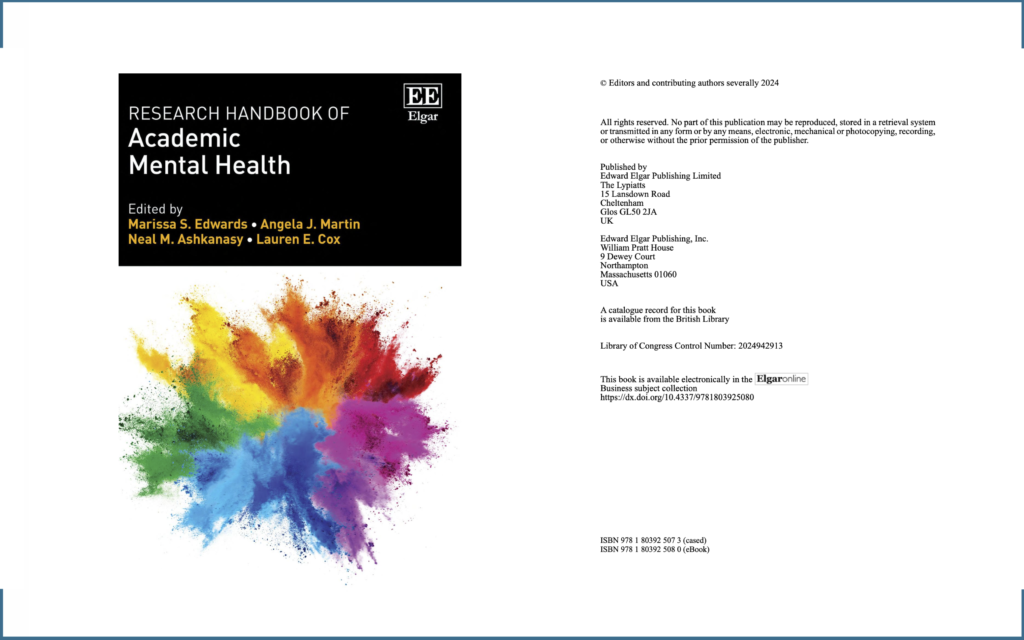
by Marissa S. Edwards, Angela J. Martin, Neal M. Ashkanasy, Lauren E. Cox (2024)
Why This Book Matters
The “Research Handbook of Academic Mental Health” examines health and well-being in university research settings. Edwards et al. (2024) offer practical guidance for PhD students facing anxiety, depression, burnout, and job insecurity.
 Curated by Business Science Daily — peer-reviewed sources, human-verified.
Learn more
Curated by Business Science Daily — peer-reviewed sources, human-verified.
Learn more
About Our Curation Process
Business Science Daily curates academic research in business and economics. Each featured study is selected from reputable, peer-reviewed journals, institutional repositories, or working papers (e.g., Elsevier, Sage, NBER, SSRN).
Articles are carefully summarized to ensure clarity and accuracy, with direct citations or links to original sources. Our process emphasizes transparency, academic integrity, and accessibility for a broader audience.
Learn more in our Editorial Standards & AI Policy.
It also shows how postdocs, early career researchers, faculty members, and university leaders can tackle these challenges together.
A Shift from Individual to Shared Responsibility
This handbook does not blame the individual. Instead, it places responsibility on the whole organization. The authors argue that universities must build psychological safety and create a true sense of belonging for everyone.
What the Handbook Offers
According to the editors, this Research Handbook provides a platform for impactful research into academic mental health. It showcases diverse methods, from quantitative studies to narrative essays.
A landmark collection examining the mental health crisis in higher education — from doctoral students to senior faculty — through lived narratives, empirical research, and systemic solutions. Over 30 chapters integrate psychology, sociology, HRM and public health.
The academic mental health crisis: scale and drivers
Doctoral students and faculty experience substantially higher rates of common mental disorders than the general population. Levecque et al. (2017): one third of PhD students at risk of psychiatric disorder. Evans et al. (2018): 41% moderate‑to‑severe anxiety; 39% depression. Australian data (2020‑21): 48% of academics stressed daily, 58% considered leaving due to work‑related mental health issues.
Barriers to change
- Stigma: fear of disclosure, discrimination, and career damage prevents help‑seeking (Pretorius, Ch.1; Oldridge, Ch.9).
- Individualised wellbeing: mindfulness and yoga workshops are insufficient when structural hazards (overwork, bullying, casualisation) remain unaddressed.
- Poor psychosocial safety climate (PSC): lack of management commitment and reactive culture.
Narratives from the inside: PhD, neurodiversity & invisible illness
First‑person stories reveal how academics navigate OCD, autism, imposter syndrome, and structural ableism. These chapters foreground voices usually silenced in metrics‑driven academia.
- Masking = camouflaging autistic traits to fit neurotypical norms.
- Leads to exhaustion, burnout, loss of authentic identity.
- Higher education is built on neurotypical expectations; peer support and double empathy are essential.
- Indonesian students in Australia: cultural humility (nggak PD) intensified IS.
- Supervisor publication pressure and pandemic isolation worsened mental health.
- Repositioning and agency helped complete PhD “by publication”.
- “Smelly Velcro Cat” – making room for obsessive thoughts while pursuing meaningful work.
- Perfectionism, overwork, and stigma delayed disclosure. Therapy notes and journaling as survival.
- PhotoVoice method: low‑income, first‑gen, BIPOC students experience structural vulnerability, food/housing insecurity, and daily microaggressions.
- Pathways for collective healing require decolonising mental health services.
Precarity, workloads and abusive environments
Precarity of work: job insecurity, fixed‑term contracts, career uncertainty. Precarity at work: bullying, discrimination, racial/gender microaggressions. Precarity from work: spillover into housing, family planning, financial instability. Academics, especially early career and casual staff, are disproportionately affected.
HRM systems & workload allocation
- Archontoulis, Townsend & Loudoun (Ch.28): time‑based workload profile systems (WPS) often unfit. Frontline managers lack training and support; inconsistent implementation leads to punitive use and burnout.
- Górska (Ch.12): Women in Central/Eastern Europe internalise sexism, adjust femininity to masculine academic culture, experiencing chronic stress and work‑family conflict.
- Lister & Spaeth (Ch.14): Professions produce “symbolic violence” – early career academics accept hierarchy and overwork as normal, damaging mental health.
Belonging, connection and advocacy as protective factors
Four domains: Competencies (social/emotional skills), Opportunities (mentoring, collaboration, social events), Perceptions (reframing rejection, self‑compassion), Motivations (autonomy, values alignment). Belonging strongly predicts mental health, job satisfaction, and retention. Leadership must actively foster inclusive climates.
- Over 100 contributors from across the globe share lived experience of mental illness, neurodiversity, and burnout.
- Podcast and blog reduce stigma, build community, and advocate for systemic change.
- Small, egalitarian groups with structured coaching (e.g., GROW model).
- Psychological safety, trust, and longitudinal support reduce loneliness and improve coping.
Strategies & solutions: from individual to organisational change
Effective mental health action requires alignment of top‑down commitment (senior leaders) and bottom‑up participation (academics, students). Preventative (job redesign), ameliorative (coping skills), and reactive (EAP) approaches must coexist.
- Longitudinal data (2014‑2021) from Norwegian university.
- Participatory screening → action planning → implementation → evaluation.
- Results: increased meaning at work, reduced work‑home conflict for both tenured and temporary staff.
- Mandatory, elective or curricular infusion of wellbeing skills (stress management, sleep, relationships).
- Leadership support and student co‑design are critical.
- Ripple effect on campus culture and student mental health.
Where to next? A psychosocial safety agenda
Universities must adopt a psychosocial safety climate (PSC) approach: senior management commitment, priority of mental health over productivity, transparent communication, and genuine worker participation. Legislation in many countries now requires managing psychosocial hazards.
- For doctoral students: fair funding, supervisor training, peer writing groups, and normalising help‑seeking. No tolerance for exploitation or bullying.
- For postdocs & early career researchers: secure career pathways, mentoring networks, workload transparency, and removing abusive SETs from promotion criteria.
- For faculty: reasonable workloads, collegial governance, parental/family support, and trauma‑informed leadership.
- For university leaders: measure PSC, act on feedback loops, invest in participatory interventions (ARK model), and embed belonging in KPIs.
Final editors’ message: The higher education sector has abundant evidence, tested interventions, and moral obligation. What is required now is courage: to redesign academic work, redistribute resources, and build universities where mental health is protected, not sacrificed for rankings.
Complete reference
Edwards, M. S., Martin, A. J., Ashkanasy, N. M., & Cox, L. E. (Eds.) (2024). Research Handbook of Academic Mental Health. Edward Elgar Publishing.
Key themes from the handbook – Narratives of neurodiversity and invisible illness (Part I); precarity, gender, race, and student evaluations (Part I); belonging, peer coaching, creativity as self‑care (Part II); organisational interventions, workload systems, and the ARK programme (Part II); integrated psychosocial safety framework (Conclusion).
This interactive summary preserves the original design, colour scheme, and structure. All content is distilled from the 2024 Research Handbook to support learning, advocacy, and institutional change.