






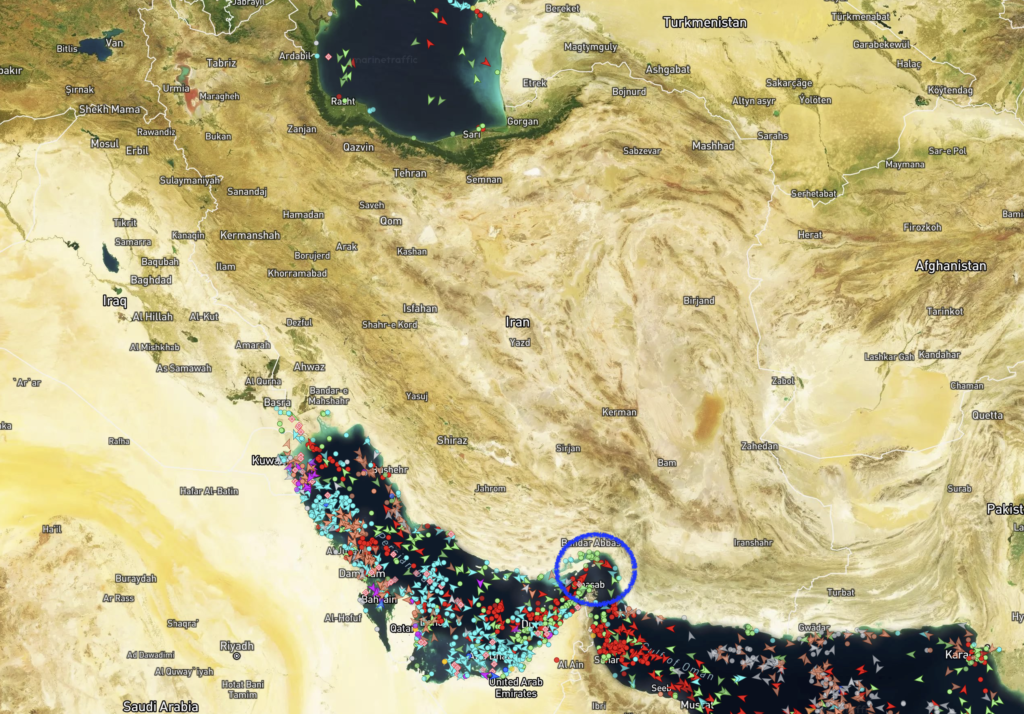
The US-Israeli war on Iran, which began 56 days ago, has pushed the already fragile Global Supply Chain (GSC) into an even more difficult situation.
 Curated by Business Science Daily — peer-reviewed sources, human-verified.
Learn more
Curated by Business Science Daily — peer-reviewed sources, human-verified.
Learn more
About Our Curation Process
Business Science Daily curates academic research in business and economics. Each featured study is selected from reputable, peer-reviewed journals, institutional repositories, or working papers (e.g., Elsevier, Sage, NBER, SSRN).
Articles are carefully summarized to ensure clarity and accuracy, with direct citations or links to original sources. Our process emphasizes transparency, academic integrity, and accessibility for a broader audience.
Learn more in our Editorial Standards & AI Policy.
All transits to and from the Strait of Hormuz have been severely impacted. Many analysts are now talking about a significant disruption — one that affects not only the regional supply chain for oil, gas, minerals, and other products, but also the future of the global supply chain.
It is expected that the global supply chain will be dramatically changed by the geopolitical risks that started at Hormuz and will continue through Bab el-Mandeb, Malacca, and other strategic chokepoints.
This subject is at the center of the paper written by Saidi, Esmaeildoost, Khankan, Masarani, and Toyasaki, focusing on ways to face geopolitical risks in global supply chains. Recently published in Transport Policy, 183 (2026), the paper provides a framework model containing Anticipatory, Adaptive, and Reconfigurable (AAR) components for managing persistent chokepoint vulnerability.
The model is built on three operational pillars: route diversification, digital risk intelligence, and public-private coordination.
You can find more about the paper through the tabs below.
Logistical Agility at the Strait of Hormuz: A Framework for Managing Sustained Geopolitical Disruption Risks in Global Supply Chains
Extending Hau L. Lee’s Triple-A framework into an Anticipatory, Adaptive, Reconfigurable (AAR) model for persistent chokepoint vulnerability — with three operational pillars: route diversification, digital risk intelligence, and public-private coordination.
Conceptualizing Logistical Agility as a Dynamic Capability
Maritime chokepoints are structurally embedded vulnerabilities within global transport networks. Traditional approaches emphasize robustness (resistance through redundancy) or resilience (recovery post-disruption). Both are reactive and insufficient for high-frequency, politically driven disruptions at strategic chokepoints like the Strait of Hormuz.
Key Definitions:
- Reactive — response after disruption
- Static safeguards (redundancy, buffer capacity)
- Focus on recovery speed
- Episodic risk assumption
- Proactive — anticipation before disruption
- Dynamic reconfiguration of systems
- Focus on exposure reduction
- Persistent structural uncertainty
Disruption Risk Classes at Chokepoints:
- Episodic: localized events (accidents, temporary congestion) — risk subsides after short duration.
- Systemic: large-scale disturbances affecting multiple regions simultaneously (pandemic, recession).
- Structural: persistently elevated disruption probability driven by geopolitical tension — this defines Hormuz.
Historical Precedents:
- Iran-Iraq “Tanker War” (1980-1988)
- 2019 attacks on Saudi Arabia’s Abqaiq facility
- 2021 Suez Canal blockage (Ever Given) — $9.6 billion/day trade disruption
- Red Sea militant attacks — 60% decrease in Suez transit
- 2017 NotPetya malware attack on Maersk ($300M+ losses)
Anticipatory, Adaptive, Reconfigurable (AAR) Framework
Lee’s foundational Triple-A model (Agility, Adaptability, Alignment) was developed for market volatility at the firm level. The AAR framework extends agility to sustained geopolitical risk at the system level — amplifying agility beyond short-term responsiveness to encompass longer time‑frame capabilities: anticipation, adaptation, and reconfiguration.
Key Distinctions: Triple‑A vs. AAR
| Criterion | Triple‑A (Lee, firm-level) | AAR Extension (system-level) |
|---|---|---|
| Temporal scope | Responsiveness to operational variability | Pre‑disruption anticipation + long‑horizon structural reconfiguration |
| Unit of analysis | Firm-level supply chains | System-level transport & infrastructure under geopolitical exposure |
| Risk context | Episodic market volatility | Persistent structural risk |
| Core capability | Responsiveness | Agility as continuous multi‑temporal capability |
Framework Dynamics:
Logistical agility does not arise from a single intervention. Route diversification alone increases costs without improved outcomes unless paired with real‑time intelligence. Structural investments in infrastructure and institutional coordination enhance long‑term agility but require sustained commitment and capital allocation. Mitigating risk involves managing trade‑offs at varying temporal scopes.
Three Operational Pillars of Logistical Agility
The interplay of anticipatory, adaptive, and reconfigurable elements gives rise to three interdependent system‑level pillars. Each pillar draws on more than one AAR dimension, emphasizing that effective policies arise from interactions, not isolated interventions.
AAR basis: Reconfigurable + Adaptive.
Existing alternatives: UAE’s Habshan‑Fujairah pipeline (1.5-1.8M bpd), Saudi East‑West pipeline. Both operate near capacity and remain vulnerable to sabotage.
Strategic port investments: Fujairah, Jeddah, Yanbu — slightly boosted throughput.
Operational indicators: Redundancy ratios, spare infrastructure throughput, number of bypass corridors.
AAR basis: Anticipatory + Adaptive.
Tools: Satellite‑enabled AIS, predictive data analytics, AI for real‑time visibility into maritime traffic, congestion, risk scores.
Outcome: Action before disruption materializes, dampening reactive behavior that amplifies crises.
Operational indicators: Monitoring coverage (AIS/satellite), decision latency between risk detection and operational response.
AAR basis: Anticipatory + Reconfigurable.
Mechanisms: Naval escort coordination, temporary insurance backstopping through public risk pools, diplomatic signaling, predefined roles for insurers and logistics operators.
Operational indicators: Frequency of joint contingency exercises, presence of risk‑sharing mechanisms, shared situational awareness platforms.
Pillar Interdependence:
The framework explains previously overlooked insufficiencies: why investment in physical infrastructure alone is insufficient without complementary digital and institutional mechanisms. By framing agility as a dynamic system capability, the framework provides a foundation for evaluating transport policy interventions and future research on multi‑chokepoint disruption scenarios.
Application of AAR to the Strait of Hormuz
The Strait of Hormuz provides a prime setting because its geographic narrowness limits rerouting flexibility, persistent geopolitical tension renders disruption probability inherently higher than other straits, and constrained bypass infrastructure means disruption management cannot rely solely on reactive measures.
Structural Risk Characteristics at Hormuz:
- Risk is not episodic — driven by military deployments, sanctions regimes, diplomatic escalations.
- Even without physical interference, insurance pricing and freight availability are impacted.
- Continuous risk evaluation frameworks needed, not reactive crisis task forces.
- Local firms must consider geopolitical risk as a persistent operating condition influencing routing and inventory decisions.
Operationalizing the Three Pillars at Hormuz:
UNCLOS & International Law Implications:
Article 38 of UNCLOS guarantees transit passage through international straits irrespective of tension. However, implementation depends on joint international determination and diplomatic activism. Multilateral agencies (IMO, G7, IORA) offer platforms to harmonize policies and coordinate maritime security. Recent US Federal Maritime Commission (FMC) investigations into chokepoint impacts on carrier capacity and freight rates signal growing awareness.
Future Research: Multi‑Chokepoint Scenarios & Empirical Indicators
Future research must shift towards worst‑case multi‑chokepoint disruption modeling — simultaneous blockages at Hormuz, Suez, Malacca, and Panama. Such scenarios would aggregate threats and inform end‑to‑end readiness planning. Research should also empirically test the AAR framework’s operational indicators.
Proposed Multi‑Chokepoint Scenario Matrix:
| Scenario | Hormuz | Suez | Malacca | Panama | Systemic Impact |
|---|---|---|---|---|---|
| Single disruption | Closed (oil) | Open | Open | Open | Regional oil crisis |
| Dual chokepoint | Closed (oil) | Blocked (container) | Open | Open | Oil + manufactured goods cascade |
| Triple chokepoint | Closed | Blocked | Pirate risk | Drought | Global trade paralysis |
| Compound (geo + climate) | Iran closure | War/terror | Overcapacity | Water level | Systemic redesign required |
Operational Indicators for Empirical Testing:
- Redundancy ratios — spare infrastructure throughput capacity
- Decision latency — time between risk detection and operational response
- Monitoring coverage — AIS/satellite coverage of chokepoint approaches
- Joint exercise frequency — public-private contingency drills
- Risk‑sharing mechanisms — insurance backstopping, mutual aid agreements
Research Gaps Identified:
- Empirical testing of AAR operational indicators (redundancy ratios, decision latency, insurance risk‑sharing mechanisms).
- Legal analysis of UNCLOS enforcement when transit passage is repeatedly violated.
- Behavioral research on how firms make anticipatory vs. reactive decisions under sustained uncertainty.
- Infrastructure economics of chokepoint bypass projects with multi‑country cost‑benefit analysis.
References
Saidi, M., Esmaeildoost, F., Khankan, R., Masarani, H., & Toyasaki, F. (2026). Logistical Agility at the Strait of Hormuz: A Framework for Managing Sustained Geopolitical Disruption Risks in Global Supply Chains. Transport Policy, 104168.
Key References from the Paper: Lee, H.L. (2021). The new AAA supply chain. Management and Business Review, 1(1), 173-176. • Bednarski, L., Roscoe, S., Blome, C., & Schleper, M.C. (2023). Geopolitical disruptions in global supply chains. Production Planning & Control, 1-27. • Shepard, J.U., & Pratson, L.F. (2020). Maritime piracy in the Strait of Hormuz and implications of energy export security. Energy Policy, 140, 111379. • Caldara, D., & Iacoviello, M. (2022). Measuring geopolitical risk. American Economic Review, 112(4), 1194-1225. • Lim, H.K., & Chiu, S.H. (2024). Resilience in maritime chokepoint disruption. Continuity & Resilience Review. • Liu, Y., et al. (2025). Bibliometric analysis on maritime transport resilience. Maritime Policy & Management, 52(3), 440-477. • Rodriguez-Diaz, E., et al. (2024). Challenges and security risks in the Red Sea. Journal of Marine Science and Engineering, 12(11), 1900.
Data Sources & Acknowledgements: US Energy Information Administration (EIA), UNCTAD, International Maritime Organization (IMO), US Federal Maritime Commission (FMC), Automatic Identification Systems (AIS) data, and historical precedent from Iran-Iraq war (1980-1988). No external funding was received for this research. The authors declare no conflicts of interest.