






The Craft of Research (5th edition, 2024) by Wayne C. Booth, Gregory G. Colomb, Joseph M. Williams, Joseph Bizup, and William T. FitzGerald is the classic guide that has helped students, and academics master the art of inquiry, argument, and clear writing.
 Curated by Business Science Daily — peer-reviewed sources, human-verified.
Learn more
Curated by Business Science Daily — peer-reviewed sources, human-verified.
Learn more
About Our Curation Process
Business Science Daily curates academic research in business and economics. Each featured study is selected from reputable, peer-reviewed journals, institutional repositories, or working papers (e.g., Elsevier, Sage, NBER, SSRN).
Articles are carefully summarized to ensure clarity and accuracy, with direct citations or links to original sources. Our process emphasizes transparency, academic integrity, and accessibility for a broader audience.
Learn more in our Editorial Standards & AI Policy.
Methodology
Rather than explaining how to search databases, format citations, or construct a bibliography, the fifth edition of The Craft of Research devotes attention to a different question on how the researcher’s relationship with an audience shapes every stage of inquiry, from question formation to final presentation.
The book’s approach is not empirical but pedagogical and philosophical. The authors framework treats research as a conversation. They argue that knowledge emerges not from discovering objective “truths” and reporting them, but from communities of researchers testing claims, offering evidence, stating warrants, and responding to objections. Overall the book operationalizes its framework through concrete heuristics:
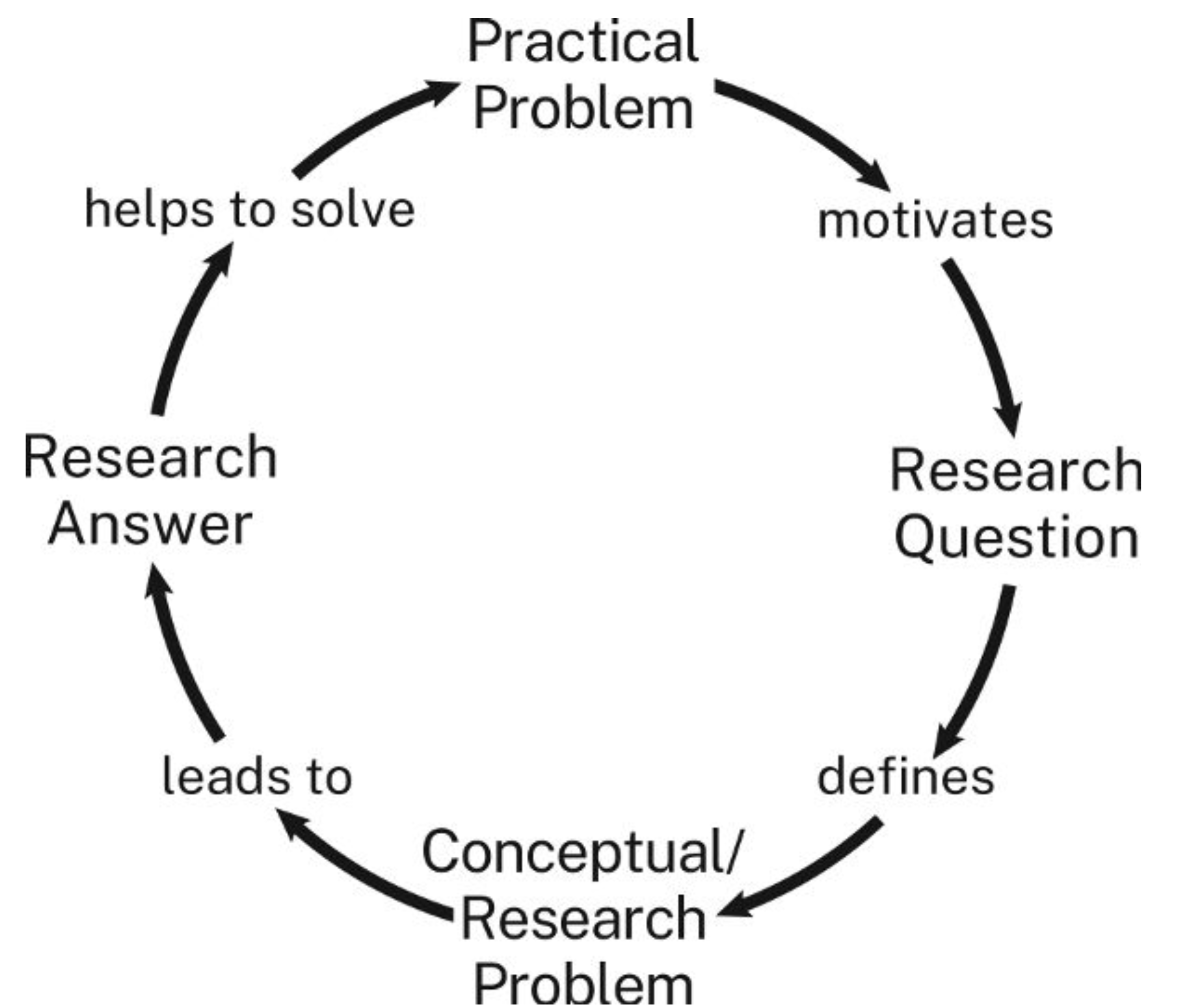
A three-step formula for moving from topic to significance: I am studying X because I want to find out Y, in order to help my audience understand Z.
A five-element argument structure: claim, reason, evidence, warrant, acknowledgment and response.
A top-down revision method prioritizing global structure over sentence-level polish.
Booth, W. C., Colomb, G. G., Williams, J. M., Bizup, J., & FitzGerald, W. T. (2024). The craft of research. University of Chicago Press.
Specific, Real-World Guidance
The book also offers field-tested, and transferable techniques.
On audience analysis: A checklist asks researchers to identify whether their audience expects entertainment, new factual knowledge, help solving a practical problem, or deeper conceptual understanding. Each answer changes how evidence is selected and presented.
On source evaluation: The book distinguishes primary, secondary, and tertiary sources not as fixed categories but relative to the research question. A newspaper article is tertiary for a political scientist but primary for a media studies researcher analyzing framing. This relativity forces researchers to justify their source choices rather than apply labels mechanically.
On note-taking: An e.g. note card shows a researcher recording a source on eighteenth-century swearing. The card includes bibliographic data, a summary, a direct quotation, and — crucially — the researcher’s own questions in brackets: “[Way to think about swearing today as economic issue? … A gender issue here?]” This embeds critical thinking into the recording process itself.
On visual evidence: Chapter 13 provides specific design rules. For bar charts, the authors advise ordering bars to match the message, not alphabetically. For line graphs, they recommend plotting no more than six lines per graph and labeling lines directly rather than relying on a legend. They also demonstrate how truncating a vertical axis from 0 to 100 versus 80 to 100 changes perceived slope and can mislead readers.
On generative AI: A quick tip to researchers on how to explore AI tools, communicate with teachers about acceptable use, be honest, be critical (AI can invent citations), and be transparent about how the tool was used.
Scaling: Small Individual Choices Multiply into Large Effects
Individually, each of these techniques may appear modest. Choosing a specific verb over a nominalization, adding a warrant sentence, or moving a key term to the end of a paragraph takes seconds.
Across a 10-page paper — roughly 5,000 words — these micro-decisions accumulate. A paper with subjects as characters and actions as verbs reduces reading time and cognitive load.
A paper that states its main claim near the end of the introduction rather than the conclusion reduces the chance that a reader will misinterpret the argument.
A paper that acknowledges a counterexample before the audience thinks of it increases the likelihood that the audience will trust the researcher’s impartiality.
When multiplied across a classroom of 30 students, each writing one research paper, the aggregate effect is measurable in fewer unclear sentences, better-supported claims, and more efficient grading.
When scaled to a graduate seminar, a doctoral dissertation, or a peer-reviewed journal article, the same principles separate work that enters a field’s conversation from work that merely summarizes it.
The classic guide to research, argumentation, and writing — fully updated for today’s researchers. From framing a question to building a compelling argument and communicating it clearly. Essential for students, academics, and professionals.
Asking questions, finding problems
Authentic research begins not with a topic but with a genuine question whose answer is not known in advance. Move from an interest → to a focused topic → to a research question → to a problem your audience cares about. The crucial test: “So what?” If your audience wouldn’t miss the answer, you don’t yet have a problem worth solving.
Finding a good research problem
- Look for contradictions, puzzles, or gaps in what you read: “Source says X, but I think Y because…”
- Read the last pages of articles and books — authors often list unanswered questions.
- Talk to people — librarians, experts, peers. Explain your project aloud; their questions reveal what needs clarifying.
- Don’t panic if someone has already answered your question — you can extend, qualify, or challenge their answer, or find a new angle.
Sources, evidence, and active engagement
Primary sources = raw data / original materials (letters, lab results, interviews). Secondary sources = scholarly literature that analyses primary sources. Tertiary sources = encyclopedias, textbooks, Wikipedia (good for orientation, not for final evidence). The classification depends on your research question: a secondary source becomes a primary source if you study the author or the field itself.
- Use library catalogs, databases (JSTOR, PubMed, Google Scholar), and librarians.
- Follow bibliographic trails (backward citation) and citation indexing (forward citation).
- Evaluate: relevance (skim indexes, abstracts, intros/conclusions) and reliability (peer‑review, reputable press, author credentials, currency).
- Read generously first (understand the source), then critically.
- Take systematic notes: always record full bibliographic info first. Distinguish your own words from quotations/paraphrases.
- Annotate, summarise, question, disagree. Reading for a problem means looking for creative agreement (extend a claim) or creative disagreement (challenge classification, evidence, or reasoning).
Making a research argument
1. Claim = what you want your audience to believe. 2. Reasons = statements that support the claim. 3. Evidence = data, facts, quotations that back up the reasons. 4. Warrant = a general principle that shows why a reason is relevant to the claim. 5. Acknowledgment & response = anticipating and answering questions, objections, and alternative views. A research argument is a conversation, not a combat.
- Specific: “Remote work threatens urban social fabric by reducing transit ridership and downtown foot traffic” not “Remote work is bad.”
- Significant: how much does it change what your audience thinks?
- Contestable: if its opposite is obviously false or trivial, it’s not worth arguing.
- Qualify your claim with hedges (“probably,” “suggests”) and limiting conditions to enhance credibility.
- State a warrant when your audience might not see how a reason supports your claim, or when the principle is controversial.
- Example: “In early 18th‑c. New England, wills listed valuable household objects; therefore, if a will doesn’t mention a clock, the testator probably didn’t own one.”
- Test warrants: are they reasonable, appropriately limited, superior to competing warrants, appropriate to your field, and do they actually cover your reason and claim?
Writing, revising, and clear style
Write to remember, to understand, and to test your thinking. Use a storyboard (index cards or digital) to visualise your argument: main claim, reasons, evidence, warrants, and responses. Sketch a working introduction (context → problem → response). Avoid three flawed patterns: a narrative of your thinking, a patchwork of sources, or a direct answer to an assignment’s wording.
Quick revision strategy (Quick Tip, Ch.15)
- Diagnose: highlight the first 6–7 words of each sentence. Do they name a character (concrete subject)? Are the verbs important actions?
- Revise for flow: begin sentences with old/familiar information, end with new/complex information.
- Read aloud: if you stumble, your readers will too.
- Use the active/passive voice intentionally: passive is useful when you want to put familiar information at the start, not because it’s “more objective.”
Ethics of research and scholarly community
1. To yourself: personal integrity — do not plagiarise, fabricate data, misrepresent sources, or conceal objections you cannot rebut. 2. To your audience and fellow researchers: honour the trust they place in you; acknowledge alternative views; cite sources fully; respect the work of others. 3. Social responsibility: consider how your research affects people, especially those who are marginalised or vulnerable. Use institutional review boards (IRB) when working with human subjects.
- It allows readers to find your evidence and retrace your steps.
- It honours intellectual debts and sustains the research community.
- It protects you from charges of plagiarism (even inadvertent).
- Different fields use different citation styles (Chicago author‑title, author‑date, MLA, APA) — follow the conventions of your community.
- Record bibliographic info before you take notes.
- Clearly distinguish your own words from quotations and paraphrases in your notes.
- Signal every quotation with quotation marks or block format, even if you cite the source.
- Don’t paraphrase too closely — change both words and sentence structure.
- When in doubt, cite. It’s better to seem naive than dishonest.
Advice for teachers (and learners) – Ch.18
- Create genuine rhetorical contexts: ask students to address real audiences who need their answers.
- Embrace the messiness of learning: research is not linear; false starts and dead ends are part of discovery.
- Use interim deadlines and peer response groups. Writing is thinking, and thinking improves with conversation.
- Teach ethics by design: meaningful assignments and authentic audiences reduce the temptation to cheat or misuse AI.
Complete reference
Booth, W. C., Colomb, G. G., Williams, J. M., Bizup, J., & FitzGerald, W. T. (2024). The Craft of Research (5th ed.). University of Chicago Press.
Key themes – Turning topics into research problems (Ch.1–2); finding and evaluating sources (Ch.3–4); building arguments with claims, reasons, evidence, warrants, and acknowledgments (Ch.5–9); planning, drafting, revising (Ch.10–11); incorporating sources and avoiding plagiarism (Ch.12); writing clear, direct prose (Ch.15); delivering presentations (Ch.16); ethics and social responsibility (Ch.17).
This interactive summary preserves the original design, color scheme, and structure of the Research Handbook layout, adapted for The Craft of Research. All content is distilled from the 5th edition to support learning, teaching, and scholarly writing.