






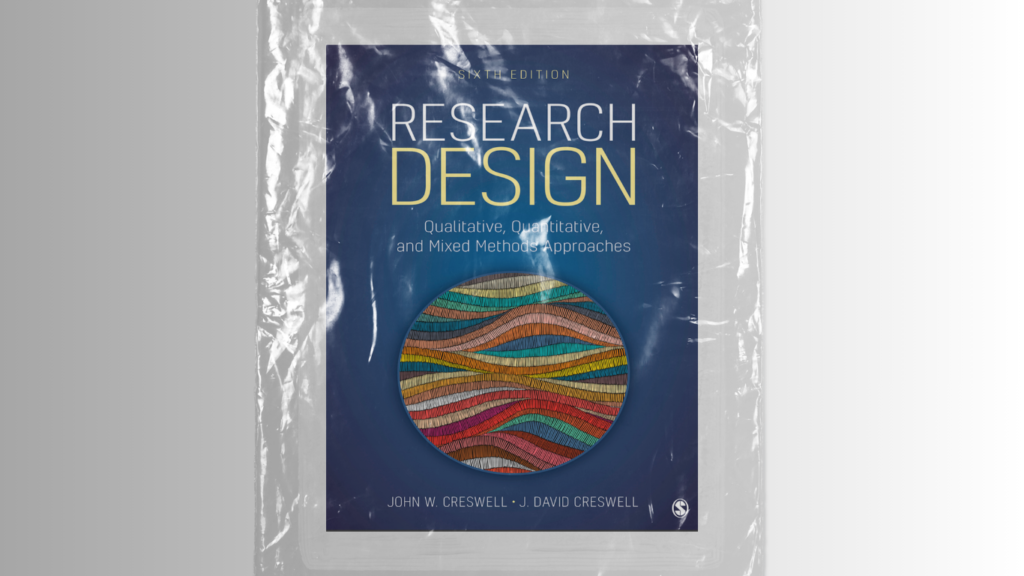
Creswell and Creswell’s sixth edition, published by SAGE in 2023, compares three broad approaches: quantitative, qualitative, and mixed methods. The book places them side by side. Not to declare a winner. To show how each tradition—with its own philosophical baggage, its own procedural logic, its own criteria for what counts as knowledge—produces fundamentally different kinds of inquiries.
 Curated by Business Science Daily — peer-reviewed sources, human-verified.
Learn more
Curated by Business Science Daily — peer-reviewed sources, human-verified.
Learn more
About Our Curation Process
Business Science Daily curates academic research in business and economics. Each featured study is selected from reputable, peer-reviewed journals, institutional repositories, or working papers (e.g., Elsevier, Sage, NBER, SSRN).
Articles are carefully summarized to ensure clarity and accuracy, with direct citations or links to original sources. Our process emphasizes transparency, academic integrity, and accessibility for a broader audience.
Learn more in our Editorial Standards & AI Policy.
It is shown that the postpositivist running an experiment is not doing the same thing as the constructivist conducting interviews, and pretending otherwise is a disservice to both.
For previously published book reviews, check the following links:
The synthesis through the chapters draws on key sources:
postpositivism for quantitative, constructivism and transformative frameworks for qualitative, and pragmatism for mixed methods.
Examples are pulled from published journal articles, dissertations, and proposals across psychology, education, nursing, public health, and organizational studies.
What distinguishes the three approaches?
Simply put, each method answers a different kind of research question. Quantitative research tests objective theories by examining relationships among variables. A survey might examine job motivation among educators in correctional institutions (DeGraw, 1984). An experiment might test how website design affects purchase behavior among vulnerable consumers (Esposito et al., 2017).
The structure is fixed:
- Introduction
- Methods
- Results
- Discussion
You know what you’re getting.
Qualitative research explores meaning. A phenomenological study examines the lived experiences of mothers who lost a baby (Lauterbach, 1992). A grounded theory study develops a framework explaining how African American women integrate physical activity into their lives (Harley et al., 2007). An ethnographic study explores cultural beliefs among British-born Pakistani and Bangladeshi young men (Mac an Ghaill & Haywood, 2015). The structure is flexible. Sometimes maddeningly so, if you’re the sort of person who likes clear templates.
Mixed methods do both. Collects quantitative and qualitative data. Integrates them. Draws metainferences from the combination. A convergent design might compare crash data with stakeholder perspectives to develop an older driver safety intervention (Classen et al., 2007). An explanatory sequential design might survey doctoral students, then interview them to explain the statistical findings (Ivankova & Stick, 2007). An exploratory sequential design might qualitatively explore social workers’ experiences with client violence, then use those findings to develop and validate a questionnaire (Enosh et al., 2015).
It sounds elegant. In practice, it’s demanding—more data, more analysis, more integration challenges. The book doesn’t sugarcoat that.
What the book provides
Ten chapters. Learning objectives. Key terms. Writing exercises. Additional readings.
The quantitative chapter covers surveys and experiments: sampling, instrumentation, power analysis, ANOVA, ANCOVA, and regression.
The qualitative chapter covers purposeful sampling, observations, interviews, documents, audiovisual materials, coding, thematic analysis, triangulation, and member checking.
The mixed methods chapter covers integration, joint displays, complex designs embedded within experiments, case studies, participatory action research, and evaluations.
What’s New in the Sixth Edition
The sixth edition brings meaningful updates. Each chapter opens with learning objectives. Small change, but it helps.
The quantitative methods chapter has been reorganized and expanded, and there’s now a consistent structure across the three methods chapters—so you’re not constantly reorienting yourself as you move from one approach to the next. That consistency reduces cognitive friction. It lets you focus on what actually differs.
The authors have refreshed references and examples throughout.
The fifth edition was showing its age in places. New tables clarify distinctions that often trip students up—research problem, purpose statement, research questions—and additional tables define specialized terminology, including mixed methods vocabulary.
For a more intuitive overview, explore the tabs below.
Worldviews, designs & methods
Research is a plan that intersects philosophical worldviews (postpositivist, constructivist, transformative, pragmatic), research designs (quantitative experiments/surveys; qualitative ethnography/case study; mixed methods convergent/sequential), and research methods (data collection, analysis, interpretation). The choice among qualitative, quantitative, or mixed methods flows from the problem, personal experience, and audience (Ch 1).
Criteria for selecting an approach
- Research problem: quantitative = factors/interventions/predictors; qualitative = explore/understand; mixed = both inadequate alone.
- Personal experience: training, comfort with structure, creative/literary style, time/resources.
- Audience: advisers, journals, funders – match disciplinary expectations.
Table 1.1 defines key terms: philosophical assumptions, research approach, research design, research methods. Figure 1.1 interconnects worldviews, designs, and methods (Ch 1).
Quantitative methods — surveys & experiments
Quantitative research tests objective theories by examining relationships among variables. Variables are measured on instruments, analyzed with statistics. The final report has a fixed structure: introduction, methods, results, discussion (Ch 1).
Key components of a method plan (Ch 8)
- Survey: population/sample, instrumentation, variables, data analysis, interpretation – include power analysis, validity/reliability of scores.
- Experiment: participants, random assignment, independent/dependent variables, treatment fidelity, internal/external validity threats, statistical tests (ANOVA, ANCOVA, etc.).
Examples: survey study on refugee mental health (Shawyer et al., 2017); experimental nudging study (Esposito et al., 2017).
Qualitative methods — exploring meaning
Qualitative research explores the meaning individuals or groups ascribe to a social/human problem. Data are typically collected in the field, emerging questions, inductive analysis, flexible reporting. The researcher is the key instrument (Ch 1, 9).
Reflexivity and validation (Ch 9)
- Researchers reflect on biases, personal history, and how these shape interpretations.
- Validity strategies: triangulation, member checking, rich/thick description, peer debriefing, external audit.
- Reliability: intercoder agreement (≥80%), codebook, consistent coding.
Examples: phenomenological study of bereaved mothers (Lauterbach, 1993); grounded theory of physical activity (Harley et al., 2007).
Mixed methods — integrating quantitative & qualitative
Mixed methods collects both open‑ended (qualitative) and closed‑ended (quantitative) data, integrates the two, and draws metainferences from the combination. It is more than just collecting two forms – integration is key (Ch 1, 10).
Core components (Ch 10)
- Joint display: table that arrays quantitative and qualitative results side‑by‑side for analysis.
- Metainferences: insights drawn from integrating the two databases (confirmation, expansion, divergence).
- Complex designs: embed core designs within experiments, case studies, participatory action research, or evaluations.
Examples: older driver safety convergent design (Classen et al., 2007); persistence in doctoral programs explanatory sequential (Ivankova & Stick, 2007).
Literature review & use of theory
The literature review shares results of prior studies, relates the study to ongoing dialogue, and provides a framework. In quantitative research, it is used deductively (to introduce theory and hypotheses). In qualitative research, it may frame the problem, appear in a separate section, or be placed at the end to compare with findings (Ch 2).
Definition of terms & style (Ch 2)
- Use operational definitions, consistent with literature.
- Follow APA 7th edition for in‑text citations, references, headings, bias‑free language.
Examples: Crutchfield’s social learning theory section; qualitative theory at the end (Creswell & Brown, 1992).
Writing strategies & ethical issues
A good proposal addresses nine core arguments (Maxwell, 2013). Structures differ: qualitative (constructivist or social justice format), quantitative (introduction/lit, method, results, discussion), mixed methods (includes integration statement, joint display).
Table 4.1 – Ethical issues across the research process
- Prior: professional standards, IRB, local permissions.
- Beginning: disclose purpose, avoid pressuring consent, respect indigenous norms.
- Collecting: respect site, avoid deception, power imbalances, exploitation.
- Analyzing: report multiple perspectives, contrary findings, use aliases.
- Reporting: avoid falsification, plagiarism, harmful disclosure; bias‑free language.
See example proposals: qualitative constructivist (Ex 4.1), quantitative (Ex 4.3), mixed methods (Ex 4.4).
Comparing approaches & validity
Key distinctions
- Deductive, theory‑testing
- Numbers, instruments, statistics
- Generalize to population
- Fixed structure
- Inductive, theory‑generating
- Words, images, themes
- Particularity, context
- Flexible structure
- Combines both
- Integration (merge/connect/embed)
- Metainferences
- Sequential or concurrent designs
Purpose statements & research questions (Ch 6‑7)
- Qualitative: single central phenomenon, exploratory verbs, open‑ended.
- Quantitative: variables, relationships/comparisons, directional hypotheses.
- Mixed: includes quantitative questions, qualitative questions, and a mixed methods integration question.
Examples: qualitative purpose (Lauterbach, 1993); quantitative survey (DeGraw, 1984); mixed methods convergent (Classen et al., 2007).
Full reference and related works
Creswell, J. W., & Creswell, J. D. (2023). Research Design: Qualitative, Quantitative, and Mixed Methods Approaches (6th ed.). SAGE Publications. ISBN‑13: 978‑1‑0718‑1794‑0.
Key chapters: Ch 1 (selection of approach), Ch 2 (literature review), Ch 3 (theory), Ch 4 (writing/ethics), Ch 5‑7 (introduction, purpose, questions), Ch 8‑10 (quantitative, qualitative, mixed methods procedures).
This digital synopsis faithfully extracts philosophical assumptions, design procedures, data collection/analysis, evaluation criteria, and writing structures from the 6th edition. For full scholarly apparatus (glossary, references, author/subject indices) see the original book.