
About Business Science Daily
Business Science Daily (BSD) is an independent platform dedicated to curating, interpreting, and presenting academic research in business, management, economics, and related disciplines.
BSD has no affiliation with ScienceDaily, any journal publisher, ranking organization, university, or research institution. Any similarity in naming is coincidental and does not imply any partnership, endorsement, ownership, or connection.
Business Science Daily is a standalone editorial initiative established to make business research more accessible to researchers, students, practitioners, and the broader public.
We are currently in an early development and adaptation phase. As the platform continues to evolve, we actively encourage feedback, suggestions, and constructive criticism from our visitors to help improve the quality, accuracy, usability, and overall experience of the website.
Our Mission
Business Science Daily seeks to bridge the gap between academic research and real-world understanding by transforming complex scholarly work into clear, accessible, and engaging insights.
We believe that important academic discoveries should not remain confined to journals and university libraries. Research has the potential to influence businesses, policymakers, educators, entrepreneurs, and society more broadly.
Our goal is to highlight impactful research while preserving academic accuracy and intellectual integrity.
Why Business Science Daily Exists
By Ali Alipour Fallahpasand, Founder & Editor
Business Science Daily began with an idea I had several years ago while studying for my master’s degree in auditing.
I was reading academic papers alongside newspapers, business magazines and other publications, and I often felt that something was missing between them. Academic research contained a great deal of knowledge about businesses, organisations, markets and management, but it was usually written for an academic audience and often remained there. Business publications, on the other hand, were much easier to follow and much closer to everyday business life, but they did not always bring the research itself into the discussion.
I started wondering why there was not a publication that could do both reasonably well: take research seriously, but make it possible for people outside academia to actually find it, understand it and engage with it.
That was the beginning of the idea.
It stayed with me for years. During that time, my own studies moved from accounting and auditing to innovation and industrial management, and eventually to doctoral research in supply chain management. Moving across these areas gave me the opportunity to encounter quite different bodies of research and different ways of thinking about business and organisations.
It also reinforced something that had interested me from the beginning. There is an enormous amount of work being done in business and management research, but only a small part of it becomes part of the wider conversation.
I have always enjoyed trying to understand these ideas and sharing what I learn with other people. That interest was there when I was an undergraduate student in accounting, and it continued through my master’s studies and later research. One of the reasons I was drawn to doctoral research in the first place was the opportunity to work seriously with questions and ideas and to discuss them with others.
In 2025, after leaving my doctoral programme and taking some time to reconsider the direction I wanted to take, I returned to the idea.
This time, I decided to build it.
Business Science Daily was launched later that year.
The purpose of the publication is fairly simple. There is valuable research being produced all the time, and I want to help more people find it.
That includes academics and students, but it is not limited to them. Managers, professionals, journalists, entrepreneurs and curious readers can also have a reason to understand what researchers are finding and debating.
The challenge is doing this without turning research into something it is not.
A scientific paper can take years to produce. It can contain a complicated method, a narrow research question, qualifications around its findings and disagreements with previous work. Removing all of that in order to make an article easier to read can sometimes make the result misleading.
At the same time, there is little point in presenting research in a way that makes it unnecessarily difficult for everyone except specialists.
This is where I see the role of Business Science Daily.
The website covers a broad range of subjects across business and management, including organisations, strategy, marketing, accounting, economics, innovation, operations, supply chains and related areas. We also look at theories, books, research methods, influential academic works and debates that can help readers understand how business knowledge has developed and where it may be heading.
Not everything we publish will be about the latest paper or the newest business trend. Some older research remains highly relevant. Some ideas become so familiar that they are worth examining again. And sometimes the most interesting subject is a disagreement rather than a conclusion.
Business Science Daily is currently free to access. I want to keep it that way for as much of the publication as possible. One of the reasons I started the website was precisely the belief that access to useful knowledge should not be limited only to people who can afford it.
At the same time, keeping an independent publication running and developing it further involves real costs and considerable work. As Business Science Daily grows, there may eventually be parts of the website or particular services that need to be supported through subscriptions or other forms of paid access. If that happens, the intention will be to keep the core of the publication as open and accessible as possible.
I do not want the financial side of the publication to determine what knowledge people can access. Finding a sustainable way to maintain the website while preserving that principle is something I will continue to think about as the project develops.
Business Science Daily is an independent publication. I founded it and currently handle the main editorial and operational work behind it. It is still a small project, and I am comfortable with that. Building a publication properly takes time.
I also do not want the website to become something that simply publishes whatever happens to attract the most clicks.
Readers’ attention matters, of course. But it is not the only measure of whether something is worth publishing.
The website will change as it develops. Some things will work; others will not. Readers will notice things that I miss, disagree with interpretations, suggest subjects and point out mistakes. I consider that part of building the publication rather than something separate from it.
The original question that led to Business Science Daily was about the distance between research and the wider world.
That question is still there.
The difference is that now there is a place where I can try to do something about it.
Research & Content Framework
Sources We Draw Upon- Peer-reviewed academic journals
- University research outputs
- Working papers and preprint repositories
- Public institutional datasets
- Research reports and expert commentary
- Evidence-based academic literature reviews
- Identification of relevant and credible academic research
- Independent synthesis of scholarly findings
- Verification of factual claims against original sources
- Translation of technical language into accessible content
- Attribution and citation whenever possible
Business Science Daily does not claim ownership of any underlying academic research. Intellectual property rights remain with the original authors, publishers, and copyright holders.
Any interpretations, summaries, syntheses, visualizations, rankings, commentaries, or educational discussions published on BSD reflect independent editorial work.
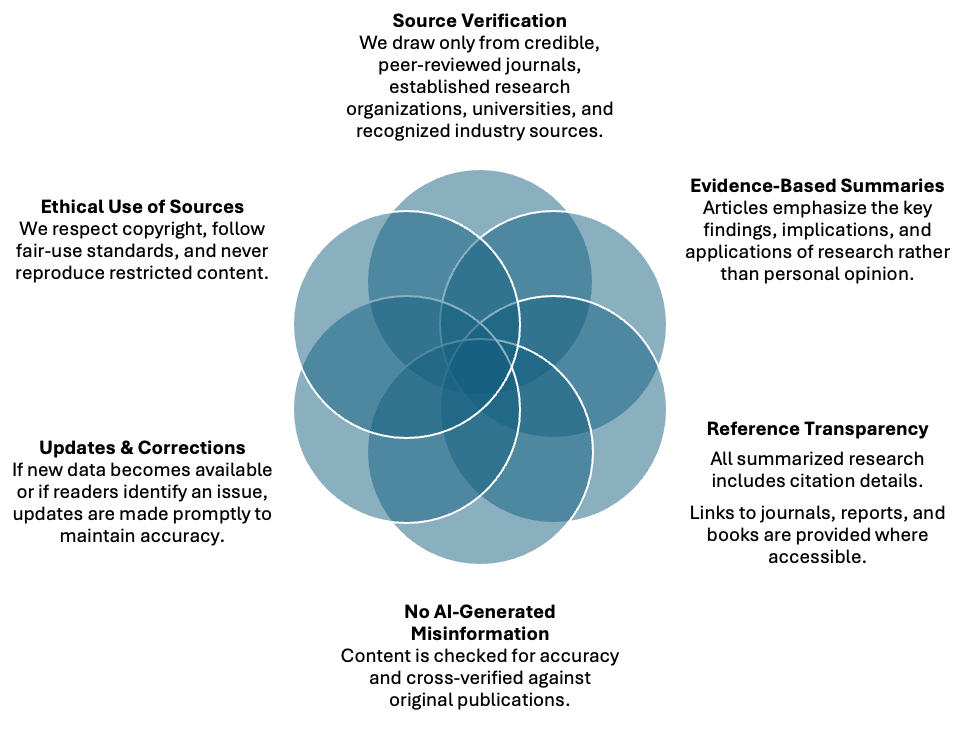
Editorial Standards
Business Science Daily follows principles of transparency, academic integrity, and responsible communication.
- Content is reviewed prior to publication.
- Original sources are consulted whenever possible.
- No full academic papers are reproduced.
- Information is presented for educational and informational purposes.
- Corrections and updates are implemented when necessary.
About the Editor & Founder
Ali Alipour Fallahpasand is the founder and editor of Business Science Daily. He has academic training in accounting, auditing, innovation and industrial management, and has conducted doctoral research in supply chain management.
His editorial focus is centered on identifying meaningful research findings and translating them into practical and understandable knowledge.
- Academic literature synthesis
- Research interpretation
- Knowledge translation
- Business and management scholarship
- Research communication
AI Usage Policy
Business Science Daily embraces technological innovation while maintaining human responsibility and editorial oversight.
Artificial intelligence tools may occasionally assist aspects of the editorial workflow; however, AI is never used as a substitute for human judgment, authorship, fact-checking, or interpretation.
Permitted Uses
- Grammar and language improvement
- Formatting assistance
- Translation support with human review
- Readability enhancement
- Content organization
Prohibited Uses
- Fully automated article publication
- Fabrication of facts or research findings
- Misrepresentation of academic evidence
- Creation of deceptive content
- Publication without editorial review
Ultimate responsibility for all published material remains with the human editor of Business Science Daily.
Important Notice
Business Science Daily remains under active development. New features, improvements, and refinements are continuously being introduced as the platform grows.
At present, there are no subscription plans, paywalls, premium memberships, or advertising-based monetization systems in place.
All articles, reports, resources, rankings, and website features are currently available free of charge.
We sincerely appreciate feedback from our readers and encourage visitors to contact us with suggestions, corrections, comments, or ideas for improvement.