







By BSD –
 Curated by Business Science Daily — peer-reviewed sources, human-verified.
Learn more
Curated by Business Science Daily — peer-reviewed sources, human-verified.
Learn more
About Our Curation Process
Business Science Daily curates academic research in business and economics. Each featured study is selected from reputable, peer-reviewed journals, institutional repositories, or working papers (e.g., Elsevier, Sage, NBER, SSRN).
Articles are carefully summarized to ensure clarity and accuracy, with direct citations or links to original sources. Our process emphasizes transparency, academic integrity, and accessibility for a broader audience.
Learn more in our Editorial Standards & AI Policy.
Servaas Storm‘s 2025 working paper argues that generative AI has hit a wall, corporate pilots are failing, and the U.S. economy is built on a risky geopolitical bet.
A new research working paper from the Institute for New Economic Thinking (INET) delivers a sharp warning: the much-hyped AI boom fueling the U.S. stock market and economy is a speculative bubble.
Dr. Servaas Storm is an economist and senior researcher at TU Delft’s Faculty of Technology, Policy and Management. He focuses on productivity growth, technology-induced structural change, climate and energy economics, and macroeconomic distribution, and has co-authored award-winning work on macroeconomics .
The paper, The AI Bubble and the U.S. Economy: How Long Do ‘Hallucinations’ Last? by economist Servaas Storm, has three main pillars.
The Foundation is Cracking
The article argues that the current technology strategy has reached its limits. The industry remains intensely focused on “scaling,” investing more data, chips, and energy into ever-larger Large Language Models (LLMs). Yet, this strategy is yielding rapidly diminishing returns.
The paper argues that these models are not developing true reasoning or understanding. Studies from Apple, MIT, and Arizona State University show that LLMs are sophisticated pattern matchers. They simulate reasoning rather than actually possessing it. Storm (2025) explains that these models fail at basic logic puzzles and cannot infer fundamental physical laws from their training data. They are becoming increasingly prone to confident fabrication, also known as ‘hallucinations.
From Tech Problem to Economic Vulnerability: The Bubble Mechanics
The author moves beyond a simple critique of technology and illustrates an urgent economic warning, showing how such technological optimism has fueled a classic financial bubble.
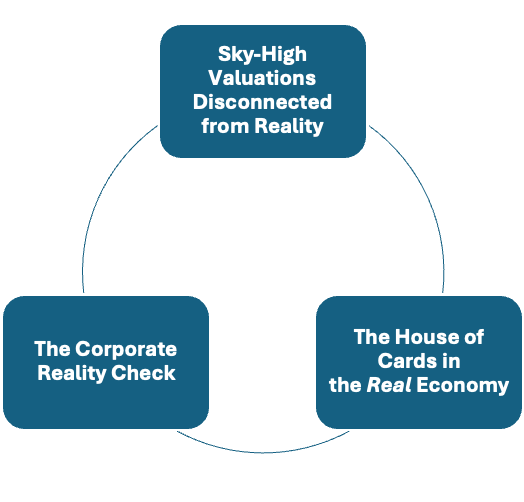
Sky-High Valuations Disconnected from Reality: The paper compares today’s market to the dot-com bubble.
It’s referring to Nvidia’s sky-high price-to-earnings ratio; Oracle’s stock jump after a shaky deal with OpenAI; and the soaring share prices of tech giants like Apple and Microsoft. The author suggests that this bubble might be even bigger.
The Corporate Reality Check: According to the MIT NANDA study, 95% of GenAI pilot projects fail to boost revenue, which is a bombshell data point. It provides concrete evidence that the promised productivity revolution isn’t materializing in enterprise workflows. Anecdotes of companies like Klarna walking back AI-driven layoffs reinforce this.
The House of Cards in the Real Economy: The other observation is that the U.S. GDP growth is being significantly propped up by data center investment. This means the broader economy is becoming dependent on capital expenditure (CapEx) in an asset class—AI data centers—that has a 3-5 year depreciation cycle, not the 50-year life of traditional infrastructure like railroads. This creates a fragile, short-term growth engine dependent on continuous, massive reinvestment.
The Geopolitical Gambit That Backfired
The other contribution of the paper is framing the bubble as a geopolitical miscalculation.
The U.S. decided that winning the race to build super-intelligent AI (AGI) against China was the single most important thing for its future power and security. It was seen as a “winner-takes-all” contest.
This “national emergency” mindset made everyone—investors, companies, politicians—feel like they had to pour money into AI no matter what. It shut down serious questions about whether the technology was actually working or would ever pay off. The goal (beating China) justified any amount of spending.
While the U.S. is investing trillions chasing a futuristic and unproven “holy grail” of artificial general intelligence (AGI), China is pursuing a very different strategy. Specifically, rather than trying to create God-like AI in data centers, China focuses on applying current AI capabilities to improve batteries, cars, solar panels, and manufacturing processes.
The author argues that the U.S. has “bet the farm” on a winner-takes-all AGI race with China, seeing it as a path to lasting strategic dominance. This national priority, according to the author, helped fuel financial speculation and discouraged critical scrutiny of the strategy.
Reference
Storm, S. (2025). The AI Bubble and the U.S. Economy: How Long Do ‘Hallucinations’ Last? INET Working Paper No. 240.