






By Business Science Daily –
 Curated by Business Science Daily — peer-reviewed sources, human-verified.
Learn more
Curated by Business Science Daily — peer-reviewed sources, human-verified.
Learn more
About Our Curation Process
Business Science Daily curates academic research in business and economics. Each featured study is selected from reputable, peer-reviewed journals, institutional repositories, or working papers (e.g., Elsevier, Sage, NBER, SSRN).
Articles are carefully summarized to ensure clarity and accuracy, with direct citations or links to original sources. Our process emphasizes transparency, academic integrity, and accessibility for a broader audience.
Learn more in our Editorial Standards & AI Policy.
Climate crises, pandemics, and geopolitical conflicts are tearing through global food networks, forcing countries to rewrite the rules of trade. Friendshoring—shifting supply toward politically aligned partners—is reshaping the global food supply chain like never before.
At the center of this transformation is the study conducted by Khadka, Gopinath, & Batarseh (2025), which analyzes food supply chain friendshoring using network modeling and centrality measures. It reveals how countries are increasingly turning to friendshoring—shifting trade toward politically aligned partners—leading to a more fragmented and fragile global food supply chains.
The research models international food trade as a dynamic network, where countries are nodes and trade flows are connections. By analyzing key commodities like pork and wheat (representing nearly $100 billion in trade), the study uncovers significant shifts in influence.
Key Insights
Methodology: The study models international food trade as a network. It uses centrality measures, community detection, and clustering coefficients to analyze structural changes.
Core Drivers: The 3Cs—Climate Change, Covid-19, and Conflicts—are accelerating the move away from globalization.
Case Studies: Pork and wheat, representing over $98 billion in global trade, show clear signs of realignment and fragmentation.
The methodology is multi-layered, grounded in network theory and advanced data analytics. Khadka et al. (2025) primarily collected the pork data from IHS Markit (S&P Global Market Intelligence) and the wheat data from UN Comtrade. There is also supplementary data across eleven additional agricultural commodities.
To ensure reliability, the analysis includes only trade relationships exceeding $100,000 in annual value. The focus is on the years 1995 to 2022, with a concentration on the period from 2010 onward. This captures recent geopolitical and economic disruptions.
The authors implemented the analytical process computationally using Python and the NetworkX package. Additionally, the methodology is further strengthened by robustness checks. This includes employing alternative community detection methods such as the Louvain algorithm and Asynchronous Label Propagation.
Additionally, while the study carefully distinguishes between correlation and causation, its network-based lens provides compelling evidence of how idiosyncratic shocks like sanctions lead to fragmentation, while systemic shocks like the COVID-19 pandemic can prompt temporary reconnection.
Findings
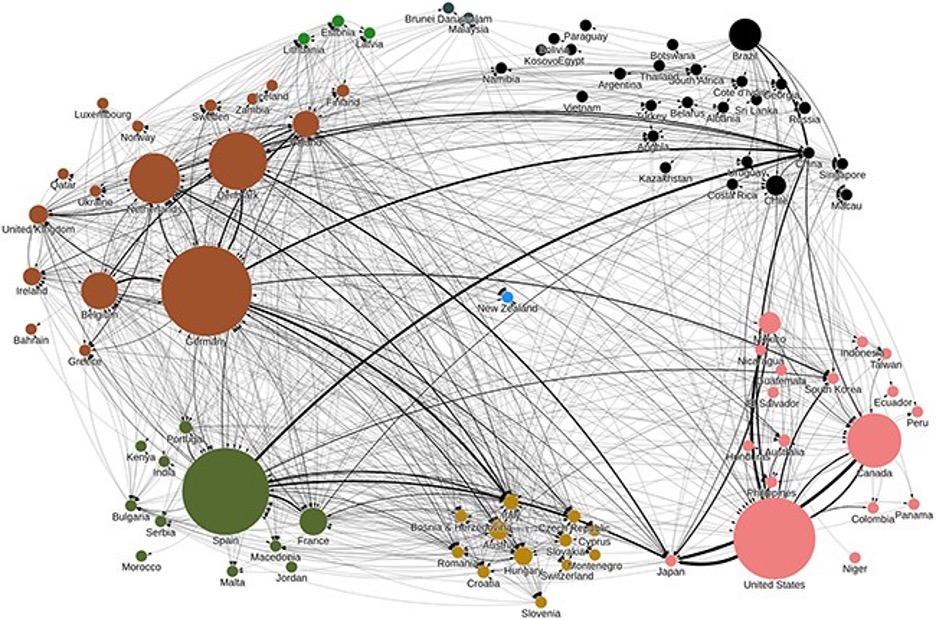
It’s revealed that food supply chain friendshoring is seen in the realignment of wheat and pork trade networks. Initially, China’s centrality has grown consistently, reflecting its expanding role as both a massive importer and a rising export force. In contrast, traditional powerhouses like the United States and Russia have seen their influence wane, particularly following the sanctions imposed after Russia’s 2014 annexation of Crimea.
Beyond individual countries, the very structure of trade is splintering. Community detection algorithms—which identify tightly knit groups of trading partners—show a growing number of smaller clusters since 2015.
This indicates that food supply chains are becoming more regionalized and politically segmented. For example, following Western sanctions, Russia swiftly pivoted its pork imports from the EU to partners like Brazil. Similarly, Turkey dramatically reduced its wheat imports from the U.S. in favor of Russian supplies amid geopolitical strains. These realignments are clear cases of friendshoring in action, where trade follows diplomatic lines rather than just comparative advantage.
However, this fragmentation carries a cost. The study finds that the global clustering coefficient—a measure of how interconnected and resilient the network is—has declined, particularly after idiosyncratic shocks like sanctions or regional conflicts.
Accordingly, A less clustered network is more brittle; a disruption in one link can cascade more easily, with fewer alternative pathways to absorb the shock. While the COVID-19 pandemic (a systemic shock) caused an initial collapse in connectivity, it was later followed by signs of tentative reintegration as countries sought stability. This contrasts sharply with the divergent, lasting impact of geopolitical decisions.
Overall, the study underscores that global food supply chains are becoming more fragile and politically divided. As countries continue to prioritize sovereignty and security over globalization, the resilience of the world’s food system may hang in the balance.
Reference
Khadka, S., Gopinath, M., & Batarseh, F. A. (2025). Friendshoring in global food supply chains. European Review of Agricultural Economics, jbae031.