






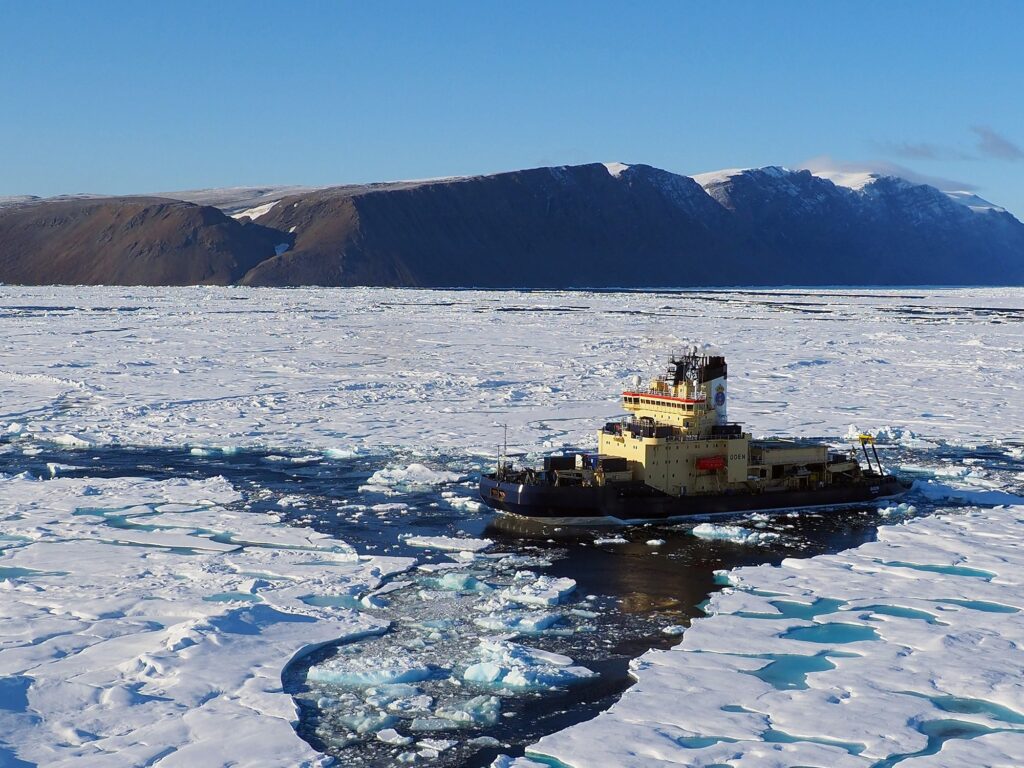
Photographed near Stephenson Island by Martin Jakobsson, Stockholm University – Source: Phys.org
By BSD –
 Curated by Business Science Daily — peer-reviewed sources, human-verified.
Learn more
Curated by Business Science Daily — peer-reviewed sources, human-verified.
Learn more
About Our Curation Process
Business Science Daily curates academic research in business and economics. Each featured study is selected from reputable, peer-reviewed journals, institutional repositories, or working papers (e.g., Elsevier, Sage, NBER, SSRN).
Articles are carefully summarized to ensure clarity and accuracy, with direct citations or links to original sources. Our process emphasizes transparency, academic integrity, and accessibility for a broader audience.
Learn more in our Editorial Standards & AI Policy.
In the examination of Arctic supply chain reliability in Baffin Bay and Greenland, Taarup-Esbensen and Gudmestad (2022) conducted an analysis that moves systematically from theoretical framing to practical and evidence-based conclusions.
The article first establishes its conceptual foundation by adopting the bow-tie risk model. The framework crucially distinguishes between preventive barriers (technologies that stop incidents) and protective barriers (responses that mitigate consequences).
” Every year an increasing number of ships venture into the region to supply, extract or transit the most northern parts of the world. However, supply chain reliability has been a significant challenge for ship operators, despite technological and organisational innovations “
The study then outlines its methodological approach, which applies the determined model to real-world problems of community supply, transit shipping, and bulk cargo operations in the high Arctic.
Accordingly, the core of the analysis is subsequently split into two corresponding parts:
First, a detailed evaluation of technological, preventive barriers—assessing advances and limitations in ship design and infrastructure.
Second, by a critical investigation of organizational protective barriers, the study reveals severe gaps in icebreaker and search-and-rescue capacity in Baffin Bay and Greenland.
Navigating the Ice: Reliability of Arctic Supply Chains in Baffin Bay and Greenland
Examining the hazards and mitigation strategies for maritime supply chains in the high Arctic, revealing critical gaps in infrastructure and emergency response despite technological advances.
Summary
This study provides a focused analysis of the reliability challenges confronting maritime supply chains in the increasingly accessible but unforgiving Arctic environment of Baffin Bay and Greenland.
The Core Challenge: Despite economic incentives and technological innovation, supply chain reliability remains a significant hurdle. The region’s industrial development and community survival depend on timely deliveries, yet schedules are frequently disrupted by days or weeks due to dynamic sea ice, severe weather, and infrastructural deficits.
The Bow-Tie Analysis: The paper employs a bow-tie model to structure the analysis, differentiating between preventive barriers (technologies like ice-class ships, improved forecasting) that stop hazards from causing an event, and protective barriers (organizational responses like icebreaker support, SAR) that mitigate consequences after an event occurs.
The Infrastructure Gap: A critical finding is the mismatch between increasing traffic and the location of essential safety infrastructure. Icebreaker and SAR capacities are concentrated in southern regions, leaving emerging shipping lanes in the high Arctic dangerously exposed.
Sectoral Focus: The analysis covers three key vessel types: community supply vessels serving remote settlements, container ships transiting potential routes like the Northwest Passage, and bulk carriers/tankers supporting extractive industries. Each faces unique but interconnected reliability threats.
The study concludes that without coordinated investment in both technological (preventive) and organizational (protective) barriers, the reliability of Arctic supply chains will remain low, stifling sustainable economic development and increasing risks for mariners and the environment.
Theoretical Framework: Bow-Tie Analysis & SC Resilience
The study is grounded in supply chain risk management theory, using the bow-tie model as a central analytical tool to understand and categorise mitigation strategies.
1. The Bow-Tie Model
This model visually maps the path from potential causes of a risk event to its potential consequences, with barriers acting as safeguards.
- Left Side (Fault Tree): Identifies potential causes or threats (e.g., severe storm, mechanical failure).
- Central Knot (Event): The undesired incident itself (e.g., ship becoming ice-bound, collision).
- Right Side (Event Tree): Outlines potential consequences of the event (e.g., delay, spill, loss of life).
- Barriers:
- Preventive Barriers: Aim to prevent the event from occurring (e.g., ice-class hull, accurate weather routing).
- Protective Barriers: Aim to mitigate impacts after the event occurs (e.g., icebreaker escort, efficient SAR response).
2. Supply Chain Risk in a Network Context
Risk is viewed as the disruption of flows (information, resources, products, finances) between interdependent nodes in a network. The Arctic context amplifies these risks due to:
- Extreme isolation and long distances between nodes.
- Lack of redundant infrastructure (ports, communications).
- Uncertain and dynamic data (bathymetry, ice charts, weather).
3. A Resilience-Based Perspective
Moving beyond pure risk prevention, the study incorporates resilience thinking—the system’s adaptive capacity to deal with, recover from, and learn from disruptions. For Arctic SCs, this means building the ability to:
- Anticipate changes in ice and weather conditions.
- Monitor the operational environment in real-time.
- Respond effectively when preventive barriers fail.
- Learn from incidents to improve future reliability.
This framework shifts the focus from merely avoiding events to building robust systems capable of maintaining function amidst inevitable Arctic hazards.
Methodology & Data
Research Design & Case Selection
The study uses a qualitative, case-based methodology to provide in-depth insights into the operational realities of Arctic shipping:
- Geographic Focus: Baffin Bay and the waters surrounding Greenland.
- Case Categories: Three types of maritime supply chain activities were analyzed:
- Community Supply Vessels: Serving remote settlements (e.g., Royal Arctic Line in Greenland).
- Transit Traffic (Container Ships): Exploring the feasibility of routes like the Northwest Passage.
- Bulk Carriers & Tankers: Supporting extractive industries (e.g., mining projects, LNG transport).
- Data Sources: Publicly available examples, company reports (e.g., Royal Arctic Line), government documents (Greenlandic, Danish Arctic Command, Canadian Coast Guard), incident reports, and scientific literature.
Analytical Procedure: Applying the Bow-Tie
1. Hazard Identification:
Arctic-specific hazards were categorized into four themes (Technical, Safety, Environmental, Reputational) based on literature and case evidence (see Table 1 in the paper).
2. Barrier Analysis:
For each case and hazard, the researchers identified:
- Preventive Barriers: Technologies implemented to prevent hazards (e.g., Azipod propulsion, ice-class hulls, satellite monitoring).
- Protective Barriers: Organisational and infrastructural capacities to respond to events (e.g., icebreaker fleet availability, SAR helicopter coverage, spill response plans).
3. Gap Identification:
The effectiveness and geographic distribution of these barriers were evaluated to identify critical vulnerabilities in the supply chain network, particularly in the high Arctic regions of northwest Canada and Greenland.
Key Findings
1. Critical Hazards to Reliability
- Dynamic Ice Conditions: Sea ice and icebergs are the most pervasive threats, capable of blocking access to ports (e.g., Ittoqqortoormiit in 2020) and transit routes unexpectedly.
- Severe Weather & Icing: Polar lows, fog, and marine icing impair navigation and equipment, with icing posing a direct threat to vessel stability and safety systems.
- Infrastructural Deficits: Many communities lack basic port facilities, requiring slow and weather-dependent barge operations. Communication and navigational data are often poor.
- Geographic Concentration of Risk: The most severe conditions and the newest shipping lanes are in areas farthest from support infrastructure.
2. Technological (Preventive) Barriers: Advances and Limitations
- Ship Design: Innovations like azimuth thrusters, double-acting ships (sailing stern-first in ice), and higher ice classes (e.g., Arc7) have improved capability.
- The Implementation Gap: Many vessels operating in the region are old (1980s/90s) and cannot be easily upgraded. New technology is expensive and not economically justified for all operators.
- Environmental Tech: Shift towards hybrid/LNG power and bans on heavy fuel oil are emerging as reputational and environmental preventive barriers.
- Case Example – Failure: Ironbark’s 2018 attempt to sail into Citronen Fjord (83°N) failed due to unanticipated ice buildup, highlighting that technology alone cannot guarantee access.
3. Organizational (Protective) Barriers: Severe Shortages
- Icebreaker Shortfall: Canada has limited icebreakers relative to its vast Arctic coastline. Greenland has no dedicated icebreakers, relying on ship ice-class or foreign assistance.
- Inadequate SAR Coverage: Helicopter SAR in the Canadian Northwest Passage is based at distant “forward operating locations.” Greenland’s few helicopters are based on the populated west coast. This violates the Polar Code’s ideal of a 5-day max rescue time in some high Arctic areas.
- Case Example – Consequence: In 2018, stretched Canadian Coast Guard resources due to southern operations caused multi-week delays for community resupply in Nunavut.
4. The Traffic-Infrastructure Mismatch
While ship traffic is increasing and moving further north (e.g., tripling in Baffin Bay region from 1990-2015), investment in the protective “safety net” has not kept pace. The core infrastructure gap leaves the entire supply chain system vulnerable to routine Arctic hazards.
Implications & Future Research
Theoretical Contributions
- Applies Bow-Tie to Arctic SCs: Demonstrates the model’s utility for structuring complex, multi-hazard risk environments.
- Integrates Resilience: Argues for viewing Arctic SC reliability through a resilience lens (adaptive capacity) rather than just a risk prevention lens.
- Highlights Network Vulnerability: Emphasizes that reliability depends on the weakest link in a network of infrastructure, not just on individual ship capability.
Practical Implications for Operators & Governments
For Shipping Companies & Industries:
- Invest in appropriate ice-class technology, but recognize its limits against extreme and dynamic Arctic conditions.
- Factor significant schedule buffer and high operating costs into Arctic business models. “Just-in-time” is not viable.
- Engage proactively with authorities on emergency planning, given the limited response assets.
For Arctic Nations (Canada, Denmark/Greenland):
- Strategic Infrastructure Investment: Prioritize icebreaker and SAR asset placement closer to emerging high-traffic or high-risk areas in the northern Arctic, not just southern hubs.
- Develop Port Infrastructure: Support the development of basic port facilities in key communities and industrial sites to reduce reliance on risky barge operations.
- Enhance Coordination: Strengthen the practical implementation of international Arctic SAR and pollution response agreements.
- Support the Polar Code: Use and further develop the IMO Polar Code as a baseline for strengthening both preventive (ship design) and protective (operational) barriers.
Limitations & Future Research
- Case-Based Generalisability: Findings are based on specific cases in Baffin Bay/Greenland; other Arctic regions (e.g., Russian Arctic with its heavier icebreaker investment) may differ.
- Data Availability: Fragmented and limited public data on precise traffic patterns and incident rates in the region.
- Dynamic Baseline: Rapid climatic and economic changes mean the risk landscape is constantly evolving.
Future Research Directions:
- Quantify the economic cost of unreliability (delays, cancellations) for Arctic communities and industries.
- Model optimal placement strategies for icebreakers and SAR assets based on projected future traffic patterns.
- Study the effectiveness of specific new technologies (e.g., hybrid power, advanced ice forecasting) in real-world Arctic operations.
- Explore governance models for funding and maintaining the “public good” of Arctic safety infrastructure amidst increasing commercial use.
References
Taarup-Esbensen, J., & Gudmestad, O. T. (2022). Arctic supply chain reliability in Baffin Bay and Greenland. Polar Geography, 45(2), 77-100.
Key Theoretical Frameworks: Bow-Tie Risk Analysis, Supply Chain Risk Management, Resilience Theory, Complex Adaptive Systems.