






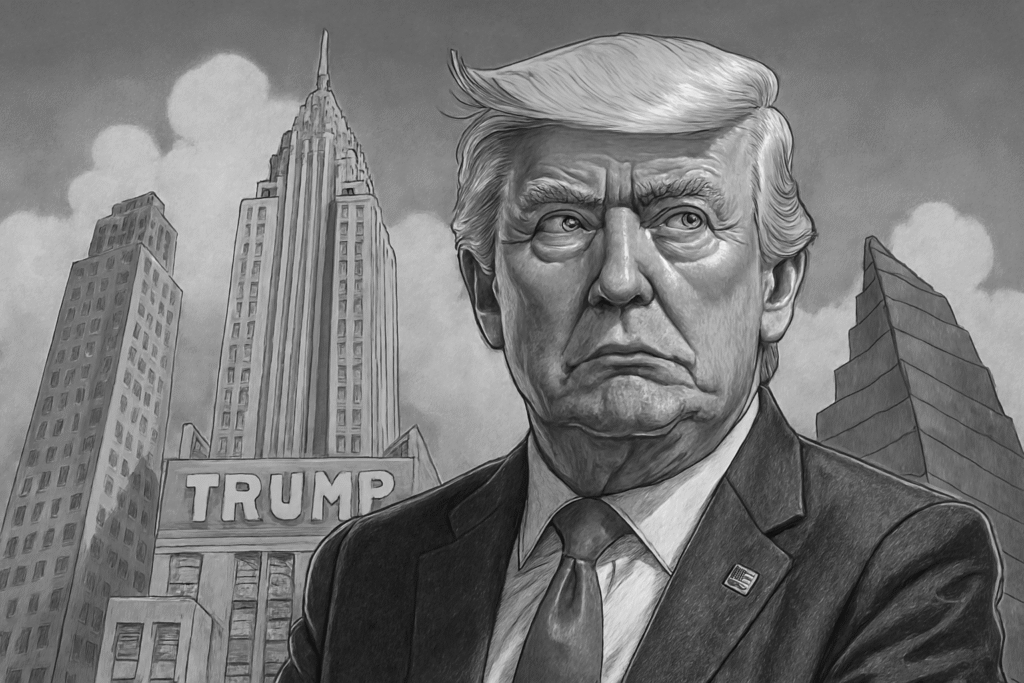
A recent paper, Batman returns! Leadership by crisis and the moral entrepreneurship of Donald J Trump written by Richard T Harrison, published in 2025, provides a sophisticated theoretical dissection of a political phenomenon often described anecdotally. This rigorous work builds a multi-layered framework to explain how Donald Trump’s leadership operates.
 Curated by Business Science Daily — peer-reviewed sources, human-verified.
Learn more
Curated by Business Science Daily — peer-reviewed sources, human-verified.
Learn more
About Our Curation Process
Business Science Daily curates academic research in business and economics. Each featured study is selected from reputable, peer-reviewed journals, institutional repositories, or working papers (e.g., Elsevier, Sage, NBER, SSRN).
Articles are carefully summarized to ensure clarity and accuracy, with direct citations or links to original sources. Our process emphasizes transparency, academic integrity, and accessibility for a broader audience.
Learn more in our Editorial Standards & AI Policy.
The Three Pillars of Trump’s Rise
The study explains that this strategy only works with the right cultural fuel. Trump’s rise was powered by three key forces:
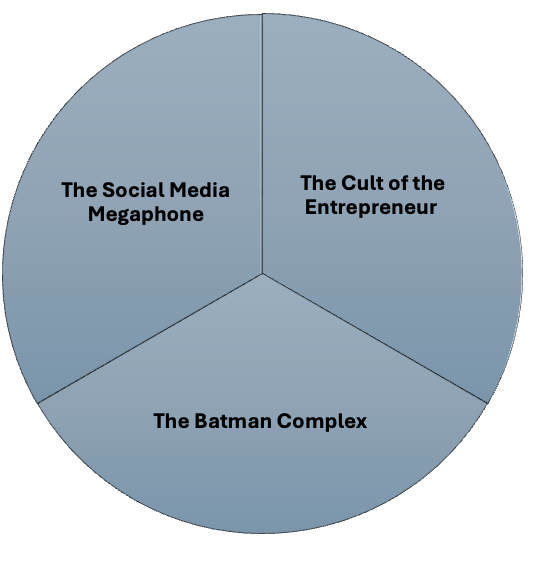
- The Cult of the Entrepreneur: Our culture often glorifies billionaire businessmen as visionary geniuses who can solve any problem, a myth Trump carefully cultivated.
- The Social Media Megaphone: Platforms like Twitter became the perfect tool for spreading what the paper calls “hype and bullshit”—communication that prioritizes emotional impact over factual truth.
- The Batman Complex: This is the most intriguing part. The paper draws a direct line between Trump and the comic book hero Batman. Not the noble hero, but the dark vigilante from stories like The Dark Knight Returns—a wealthy figure who believes the system is too corrupt to function and takes matters into his own hands, operating outside the rules to save the city.
The Theoretical Framework: Synthesizing Sociology, Leadership Studies, and Cultural Theory
The paper’s power comes from its interdisciplinary approach, weaving together several established theories to build a novel argument.
The Foundational Construct: Moral Entrepreneurship
The paper draws heavily from Howard S. Becker’s classic sociological concept of the “moral entrepreneur” from his 1963 work, Outsiders: Studies in the Sociology of Deviance.
Becker defined moral entrepreneurs as individuals or groups who create new rules and norms by labeling certain behaviors or groups as deviant. They are crusading reformers who campaign to enforce their own moral code.
Harrison argues that Trump operates as a modern political moral entrepreneur. He doesn’t just lead through existing crises but actively engages in leadership during crises. It’s the strategic construction and framing of crises (e.g., immigration, American carnage, a stolen election) to legitimize his authority and policy goals.
The Mechanism: Moral Panic Theory
Building on the work of Stanley Cohen (1972) and Goode & Ben-Yehuda (1994), the paper uses moral panic as the primary tool of the moral entrepreneur.
A moral panic involves (1) concern, which is heightened anxiety over a perceived threat. (2) Hostility that is about Increased hostility towards the “folk devils” (the targeted group). Widespread agreement that the threat is real or (3) Consensus. And, (4) Disproportionality or the reaction is far greater than the actual threat.
Richard T Harrison analyzes how Trump’s rhetoric on various issues fits this model, creating folk devils (immigrants, political elites, the swamp) to galvanize his base and create a perpetual state of urgent crisis that demands a strong leader.
The Analytical Lens: Dramaturgy & Social Drama
The paper’s primary methodological lens is borrowed from anthropologist Victor Turner (1974).
Turner argues that social conflict unfolds in a four-phase process, a social drama:
- Breach: A break from norm-governed social relations (e.g., the Make America Great Again narrative as a breach from established political discourse).
- Crisis: The breach widens, polarizing the community (e.g., the escalation of moral panics and political rhetoric).
- Redressive Action: Mechanisms are used to overcome the crisis (e.g., elections, legal challenges, impeachment).
- Reintegration/Schism: The final stage is either a reintegration of the social group or a recognition of a permanent schism.
The author uses the above dramaturgical framework to structure his analysis of Trump’s presidency and campaigns as an ongoing performance. Dramaturgy and social drama allow Trump to treat leadership not as a static set of traits, but as a dynamic, co-constructed process between him and followers over time.
Contextual Legitimation: The Batman Archetype
The Batman method is a form of cultural analysis. The paper argues that the cultural prevalence of the Dark Knight archetype provided a pre-existing script for his supporters to understand and legitimize his behavior.
Richard T Harrison connects the Batman method to Max Weber’s concept of charismatic authority, which requires cultural legitimation. The paper attunes that the superhero mythos—specifically the narrative of a billionaire vigilante who must break the rules to save a corrupt city—prepares a segment of the populace to view Trump’s norm. Breaking in this case is not considered a danger, but as a necessary solution.
The paper’s primary contribution is its synthesis. It links moral entrepreneurship with leadership-by-crisis, and then analyzes that phenomenon through the lenses of dramaturgy and cultural legitimation.
Richard T Harrison concludes that Trump’s leadership is a performative “social drama” that leverages deep-seated cultural myths and the tools of modern media to create a self-perpetuating cycle of crisis and redemption.
For scholars and informed observers, this framework offers a more nuanced and structurally sound way to analyze political movements that operate outside traditional paradigms.
Reference
Becker, H. S. (1963). Outsiders: Studies in the sociology of deviance. Free Press.
Cohen, S. (1972). *Folk devils and moral panics: The creation of the Mods and Rockers_. Routledge. https://doi.org/10.4324/9780203828250
Goode, E., & Ben‑Yehuda, N. (1994). Moral panics: Culture, politics, and social construction. Annual Review of Sociology, 20(1), 149–171. https://doi.org/10.1146/annurev.so.20.080194.001053
Harrison, R. T. (2025). Batman returns! Leadership by crisis and the moral entrepreneurship of Donald J Trump: A dramaturgical perspective. Leadership, 17427150251350615.
O’Toole, K., Talbot, S., & Fidock, J. (2008). Anecdotally speaking: Using stories to generate organisational change. Qualitative Research Journal, 8(2), 28–42.
Turner, V. (1974). Dramas, fields, and metaphors: Symbolic action in human society. Cornell University Press. (Google Books)
Weber, M. (1991). From Max Weber: Essays in Sociology (H. Gerth & C. W. Mills, Eds.; B. S. Turner, Preface). Psychology Press.