






By Business Science Daily –
 Curated by Business Science Daily — peer-reviewed sources, human-verified.
Learn more
Curated by Business Science Daily — peer-reviewed sources, human-verified.
Learn more
About Our Curation Process
Business Science Daily curates academic research in business and economics. Each featured study is selected from reputable, peer-reviewed journals, institutional repositories, or working papers (e.g., Elsevier, Sage, NBER, SSRN).
Articles are carefully summarized to ensure clarity and accuracy, with direct citations or links to original sources. Our process emphasizes transparency, academic integrity, and accessibility for a broader audience.
Learn more in our Editorial Standards & AI Policy.
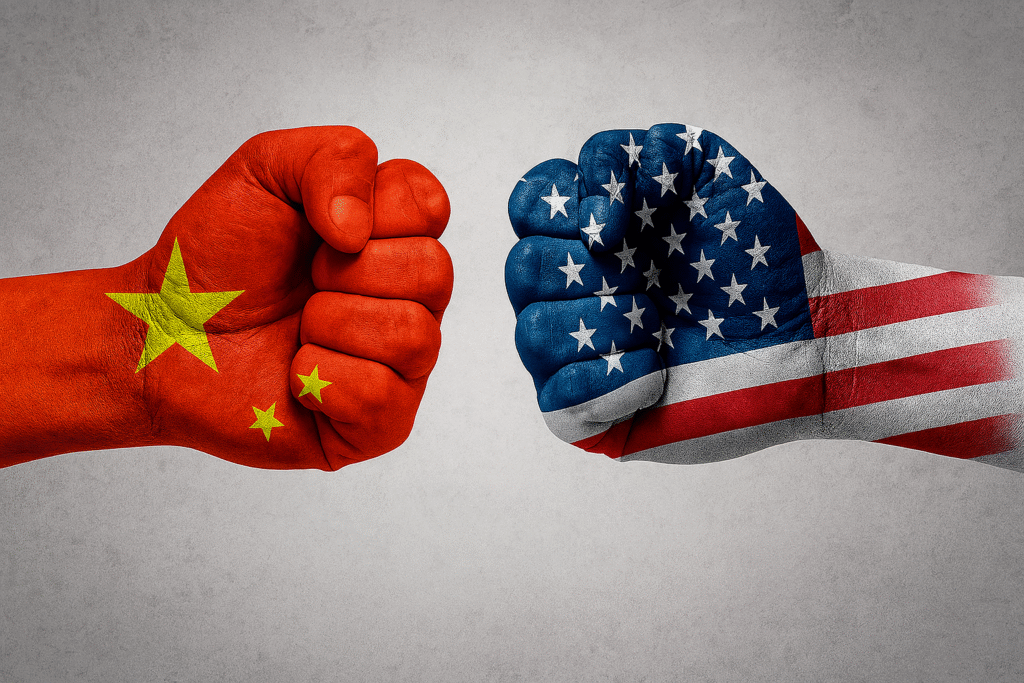
A recent study by Wang, Zeng, & Liang (2025), published in Management Decision, examined how US sanctions trigger the Innovation Herd Effect among Chinese companies.
Accordingly, 4,078 Chinese A-share listed companies were examined from 2015 to 2021. Furthermore, by using the US Department of Commerce’s Entity List sanctions as a natural experiment, researchers employed a robust difference-in-differences model to isolate the impact on non-sanctioned peers.
Behind The Findings
The Quasi-Experiment
The study’s core strength is its use of the US Entity List as a natural experiment. Researchers didn’t impose sanctions; they observed them as an external treatment applied to some firms but not others. This setup is powerful for inferring causality—a step beyond simple correlation. By comparing the innovation behavior of similar firms before and after sanctions hit their industry peers (the treatment group) against firms in unaffected industries (the control group), they could more confidently attribute changes to the sanctions themselves.
The Difference-in-Differences (DID) Engine
The multi-period Difference-in-Differences (DID) model is the workhorse of this analysis. It doesn’t just compare two groups at one point in time; it tracks them over several years (2015-2021). This design controls for time-invariant differences between firms (e.g., inherent corporate culture). And the broader temporal trends affecting all firms (e.g., China’s national innovation policy shifts). DID isolates the specific change in the treated group that occurred after the sanction event.
Theoretical Backbone
The hypotheses are built on social learning theory and competitive imitation theory. The methodology then operationalizes these concepts: the peer effect is measured by convergent changes in R&D spending and patenting, while moderators such as internationalization and loan types test the boundary conditions of these theories.
Findings
The Peer Effect Mechanism
It is observed that due the uncertainty and technological blockades caused by sanctions on their competitors, companies engage in social learning and competitive imitation. It’s proved that sanctioned firms boosting R&D to overcome “chokepoint” technologies and follow suit to avoid falling behind. This creates a homogenization, or “herding,” of innovation strategies within the industry.The Innovation Paradox
The study did also uncover a critical paradox. While innovation inputs (R&D spending) go up, innovation outputs (patents) initially go down. Researchers argue sanctions disrupt industry-wide innovation collaboration and access to high-tech components, making it harder to translate R&D spending into tangible results in the short term.
It’s found that US sanctions on specific Chinese firms cause un-sanctioned companies in the same industry to significantly increase their own R&D investment—a phenomenon researchers call the innovation peer effect.
Consequently, despite an increase in spending, these peer Chinese firms see a short-term drop in successful innovation outputs, like new patents. Hence, the effect as such is weaker in highly internationalized firms and those reliant on short-term loans. In other words, long-term loans help protect innovation results.
It’s also observed that over time, the negative impact on outputs fades, implying companies adapt and rebuild their innovation chains.
What factors moderate the effect?
The first factor is the Internationalization backfire. Highly internationalized firms, facing more complex compliance risks and disrupted global networks, show a weaker boost in R&D and a stronger drop in outputs.
Financing resources matter a lot, too. Firms with more short-term loans are less able to increase R&D due to repayment pressure. Conversely, firms with more long-term loans are better shielded from the negative impact on outputs, as stable funding supports sustained research.
The Boundaries
The Black Box of Process
The quantitative, large-sample method excelled at identifying the existence and scale of the peer effect, but cannot unpack the micro-level processes.
How exactly do executives decide to mimic peers?
What internal debates occur?
These “how” questions are left for qualitative case-study research.
The Listed Company Bias
The sample includes only A-share listed firms, which are typically larger, more resource-rich, and have better access to financing than private SMEs. The “peer effect” might look different—or be more devastating—for smaller, non-listed companies facing the
Reference
Li, J., Wang, Y., Zeng, W., & Liang, K. (2025). US sanctions and the reshaping of Chinese innovation strategies. Management Decision, 63(7), 2362-2391.
Li, J., Jiang, H., Shen, J., Ding, H., & Yu, R. (2024). Using the difference-in-differences design with panel data in international business research: progress, potential issues, and practical suggestions. Journal of International Business Studies, 55(8), 949-961.