


By Business Science Daily
 Curated by Business Science Daily — peer-reviewed sources, human-verified.
Learn more
Curated by Business Science Daily — peer-reviewed sources, human-verified.
Learn more
About Our Curation Process
Business Science Daily curates academic research in business and economics. Each featured study is selected from reputable, peer-reviewed journals, institutional repositories, or working papers (e.g., Elsevier, Sage, NBER, SSRN).
Articles are carefully summarized to ensure clarity and accuracy, with direct citations or links to original sources. Our process emphasizes transparency, academic integrity, and accessibility for a broader audience.
Learn more in our Editorial Standards & AI Policy.
For decades, tools such as Web of Science (Clarivate) (WoS) and Scopus(Elsevier) have served as gatekeepers of scholarly visibility. They have considered as powerful, but costly databases. They’ve offered services for tracking publications and citations. For researchers and institutions without -or restricted- funding, however, these paywalls created systemic barriers to participation in global research evaluation.
OpenAlex emerged in 2022, establishing itself as a fully open, free-to-use, and comprehensive catalog of global academic publications. It is developed by the nonprofit organization OurResearch, a Vancouver-based nonprofit founded by Jason Priem and Heather Piwowar. OpenAlex is funded by the Arcadia Fund. The main is mission is to make scholarly research more open, and accessible to everyone. The organization is also known for building Unpaywall, which tracks millions of open-access articles across publishers and repositories. And, ImpactStory, a tool for open researcher profiles.
The Challenge of Closed Scholarly Data
Before OpenAlex, most structured research metadata — including author networks, institutional affiliations, citation relationships, and journal records — was locked within commercial platforms (OurResearch, 2022).
Although services provided by WoS and Scopus are reliable, their subscription costs and proprietary restrictions have made large-scale research analytics inaccessible to many scholars (Culbert et al., 2025).
The barriers not only influence access but also the replicability and transparency_ specially in bibliometric studies. Mainly because researchers cannot freely share data from Scopus and WoS. Therefore, the reproducibility of bibliometric results are restricted (OpenAlex, n.d.).
Moreover, non-profit or emerging institutions often found themselves excluded from global citation analyses, rankings, and performance evaluations. OpenAlex was designed to overcome these problems. The system is built around eight interlinked entities:
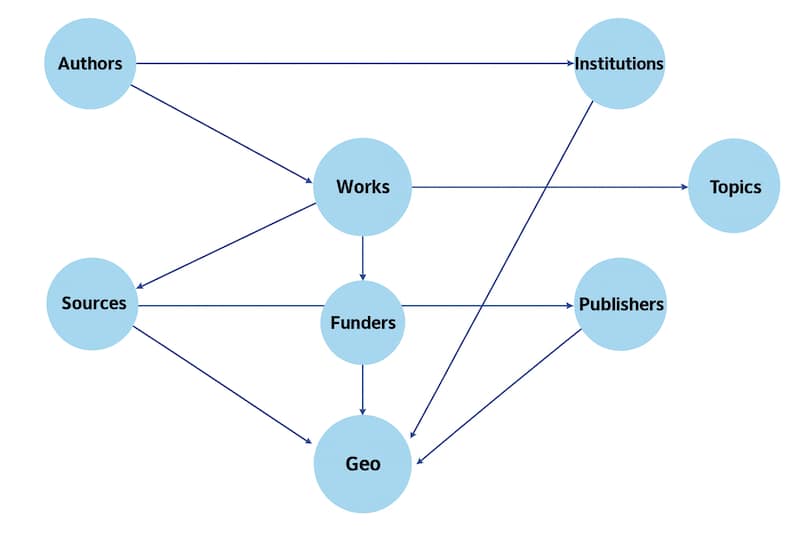
Each entity is connected through persistent identifiers including DOI (Crossref), ORCID (for authors), and ROR (for institutions). Moreover, all OpenAlex data is released under the CC0 Public Domain license, meaning it can be used, shared, and remixed without restriction. The database is accessible via a public API and bulk data dumps, updated daily — making it a dynamic and living map of global research.
Why OpenAlex Matters
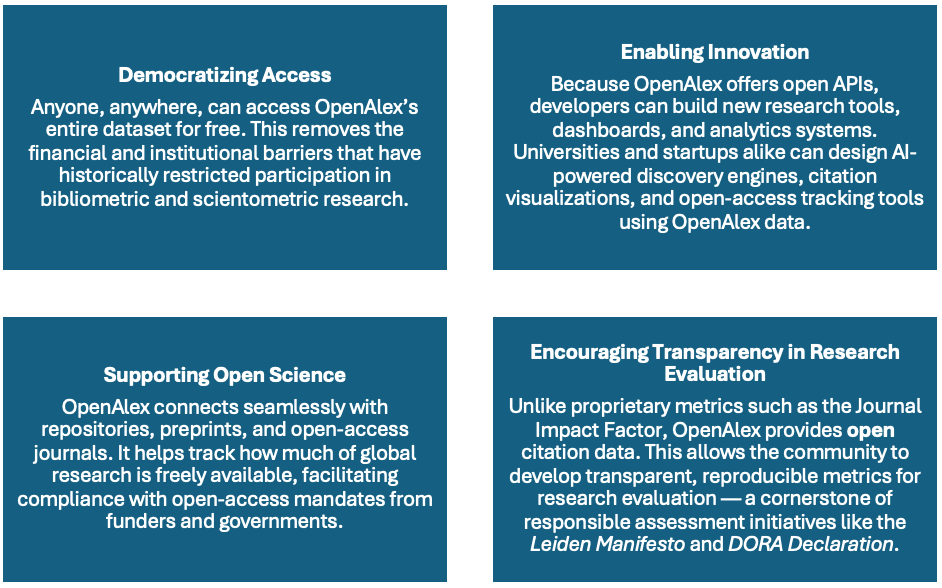
OpenAlex is more than just a database — it is an open infrastructure for global knowledge. The comparison between OpelAlex with WoS demonstrate that OpenAlex provides a far more balanced linguistic coverage than WoS (Céspedes et al., 2025). According to OpenAlex, the system’s impact can be seen in several transformative ways:
OpenAlex vs. Scopus and Web of Science
Recent studies approve that OpenAlex’s citation coverage -particularly for recent literature- is comparable to that of Scopus and Web of Science (Culbert et al., 2025; Priem et al., 2022). The data presented in the table below are taken form reference coverage analysis of OpenAlex compared to WoS and Scopus (Culbert et al., 2025). The study used a Shared Corpus—comprising only publications (2015-2022) with exact DOI matches in OpenAlex, Web of Science, and Scopus—to enable a direct and fair comparison across the three databases.
Database comparison (WoS / Scopus / OpenAlex)
| Feature | WoS ▾ | Scopus ▾ | OpenAlex ▾ |
|---|---|---|---|
| Number of Records | 71,280,830 | 65,642,377 | 243,053,925 |
| Number of References | 1,765,281,799 | 2,033,522,623 | 1,845,379,285 |
| Number of Records | 42,678,632 | 43,579,595 | 200,665,940 |
| Number of References | 1,400,958,343 | 1,422,650,789 | 1,636,497,394 |
| Number of Records | 22,609,069 | 27,620,472 | 76,836,191 |
| Number of References | 786,437,547 | 1,035,750,923 | 840,730,834 |
| Number of Records | 16,788,282 | 16,788,282 | 16,788,282 |
| Number of References | 725,008,043 | 727,056,725 | 585,616,069 |
Tip: click column headers to sort. Use the controls above to filter, export CSV, or copy.
Theron, e.g., Thelwall, & Jiang (2025) presents OpenAlex as a better option than Scopus for large-scale citation analysis mainly because of Superior Citation Data, Broader and More Effective Classification, and Cost-Effectiveness and Accessibility. Furthermore, Simard et al. (2025) argue that Unlike WoS and Scopus, which disproportionately index international, English-language journals, OpenAlex provides a more balanced and inclusive picture by fully representing nationally-focused and non-English diamond Open Access journals. This corrects a significant bias in traditional bibliometric studies.
OpenAlex vs Web of Science vs Scopus — Feature comparison
| Feature | OpenAlex ▾ | Web of Science ▾ | Scopus ▾ |
|---|---|---|---|
| Ownership | Nonprofit (OurResearch) | Commercial | Commercial |
| Access | Free and open | Subscription | Subscription |
| License | CC0 Public Domain | Proprietary | Proprietary |
| Coverage (2025) | ~250 million+ works | ~90 million | ~90 million |
| Data Access | API + bulk download | Limited API | Limited API |
| Strengths | Openness, inclusivity, broad OA coverage | Curated, stable metadata | Wide coverage, analytics tools |
Tip: click column headers to sort. Use the controls above to filter, export CSV, or copy.
Implications for Research and Publishing
The availability of open bibliometric data through OpenAlex is reshaping how the scholarly community studies itself. Researchers can now:
- Analyze global citation networks without violating licenses.
- Map institutional collaborations using reproducible methods.
- Explore underrepresented languages and regions in global scholarship.
- Build transparent dashboards for research evaluation and strategy.
For journals and publishers, OpenAlex provides an opportunity to ensure visibility without dependence on commercial indexing systems. Open-access journals, in particular, benefit from its inclusive and automated indexing approach. However, despite its significant promise as an open alternative, OpenAlex faces several challenges inherent to its collaborative and automated model.
A primary issue is metadata inconsistency, as data aggregated from diverse sources can lead to incomplete or variably formatted fields like author affiliations and document types.
Furthermore, unlike commercially curated databases such as Scopus or Web of Science, OpenAlex lacks manual quality control, which can affect data reliability. Its coverage, while broad, also exhibits a disciplinary bias, with quality often varying and being less comprehensive in non-STEM fields.
Finally, citation completeness can be an issue, as references from older publications or regional journals are sometimes missing, potentially impacting bibliometric analyses.
These issues are well-documented in recent evaluations (Alperin et al, 2024). Hence, as the platform evolves, data quality is steadily improving through community feedback and partnerships with Crossref and ROR.
The Future of Open Scholarly Infrastructure
OpenAlex’s long-term potential lies in its role as the backbone of a truly open research graph — a web of interconnected scholarly entities linking people, institutions, and knowledge. Its integration with open identifiers (DOI, ORCID, ROR) and other infrastructures (DataCite, DOAJ) positions it as the foundation for open, machine-readable scholarship.
OpenAlex is transforming data-driven business research by offering a powerful, free alternative to closed databases. It captures a wider spectrum of global scholarship, including vital but often-overlooked non-English and diamond Open Access journals. OpenAlex also enables reproducible analysis of networks and trends without cost, democratizing research capabilities. This tool is built on open identifiers (DOI, ORCID, ROR), which ensures transparency and scalability for the future. Overall, for business scholars, adopting OpenAlex means enhancing visibility, fostering collaboration, and gaining a more accurate, equitable view of global research impact.
References
Alperin, J. P., Portenoy, J., Demes, K., Larivière, V., & Haustein, S. (2024). An analysis of the suitability of OpenAlex for bibliometric analyses. arXiv preprint arXiv:2404.17663.
Céspedes, L., Kozlowski, D., Pradier, C., Sainte‐Marie, M. H., Shokida, N. S., Benz, P., … & Larivière, V. (2025).Evaluating the linguistic coverage of OpenAlex: An assessment of metadata accuracy and completeness. Journal of the Association for Information Science and Technology, 76(6), 884-895.
Clarivate Analytics. (2025). Web of Science Core Collection: Journal Coverage Report.
Culbert, J. H., Hobert, A., Jahn, N., Haupka, N., Schmidt, M., Donner, P., & Mayr, P. (2025). Reference coverage analysis of OpenAlex compared to Web of Science and Scopus. Scientometrics, 130(4), 2475-2492.
Elsevier. (2025). Scopus Content Coverage Guide. Elsevier B.V.
OpenAlex. (n.d.). What is OpenAlex? OpenAlex Documentation. https://help.openalex.org/hc/en-us/articles/24396686889751-About-us
OurResearch. (2022). What is OpenAlex? OpenAlex. https://help.openalex.org/hc/en-us/articles/24396686889751-About-us
Piwowar, H. (2022, January 6). OpenAlex launch! Blog post, OpenAlex. https://blog.openalex.org/openalex-launch/
Priem, J., Piwowar, H., & Orr, R. (2022). OpenAlex: A fully-open index of scholarly works, authors, venues, institutions, and concepts. arXiv preprint arXiv:2205.01833.
Simard, M. A., Basson, I., Hare, M., Larivière, V., & Mongeon, P. (2025). Examining the geographic and linguistic coverage of gold and diamond open access journals in OpenAlex, Scopus and Web of Science. Quantitative Science Studies, 1-29.
Thelwall, M., & Jiang, X. (2025). Is OpenAlex suitable for research quality evaluation and which citation indicator is best? Journal of the Association for Information Science and Technology.

This article “How OpenAlex Is Breaking Down Paywalls in Scholarly Research” was published on November 28, 2025, nearly five months ago. Since then the number of records in OpenAlex has gone up to >477 million. There was Walden Rewrite and other improvements. Its value has been augmented by Leiden Algorithm.
You might wish to publish an updated version as soon as possible.