






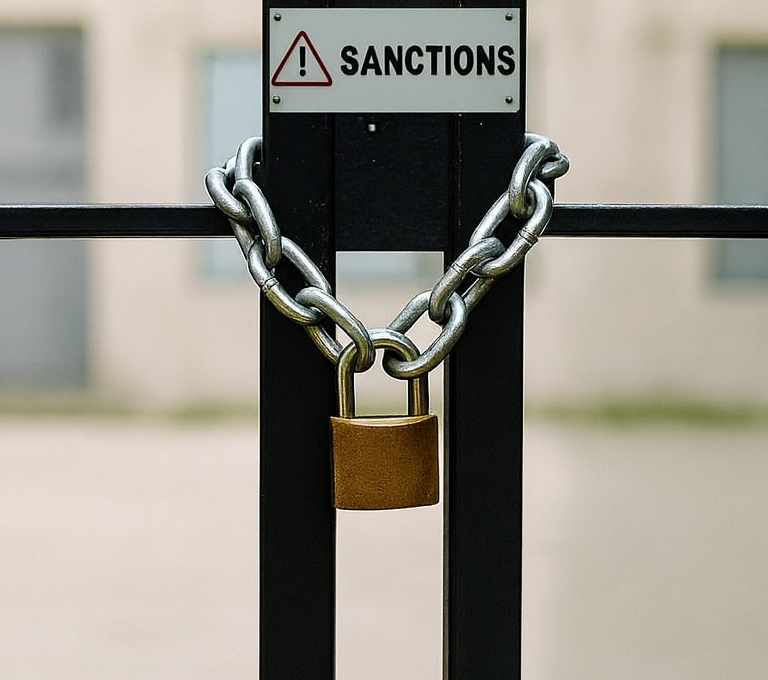
The study “International Business Under Sanctions” published in the Journal of World Business, explores how economic sanctions and non-military restrictions imposed by governments to other nations may transform the landscape of international business.
 Curated by Business Science Daily — peer-reviewed sources, human-verified.
Learn more
Curated by Business Science Daily — peer-reviewed sources, human-verified.
Learn more
About Our Curation Process
Business Science Daily curates academic research in business and economics. Each featured study is selected from reputable, peer-reviewed journals, institutional repositories, or working papers (e.g., Elsevier, Sage, NBER, SSRN).
Articles are carefully summarized to ensure clarity and accuracy, with direct citations or links to original sources. Our process emphasizes transparency, academic integrity, and accessibility for a broader audience.
Learn more in our Editorial Standards & AI Policy.
The research team, led by Professor Klaus Meyer of Ivey Business School, offers a comprehensive conceptual and evidence-based review of sanctions and their implications for firms and economies. Synthesizing data from political science, economics, and business research, the authors aim to answer a pressing question:
How do international sanctions disrupt firms and what strategies do they use to adapt?
This is followed by a series of key research questions as such:
- How do sanctions alter the institutional frameworks that shape international business?
- What are the short-term and long-term economic effects of sanctions on countries and firms?
- How do multinational enterprises in both sanctioning and sanctioned countries respond strategically?
- What can existing theories of international business tell us about these politically driven disruptions—and where do they fall short?
To answer these questions, the researchers conducted a systematic review of over five decades of scholarly evidence. A set of data include cross-country econometric studies, firm-level case analyses, and historical records. Consequently, data are integrated from global sanctions databases such as those used by Felbermayr et al., 2021. Multiple case examples are collected and analyzed. This includes data from U.S. sanctions on Cuba and Iran to the EU’s restrictions on Russia after 2014 and the U.S.–China technology conflict.
The paper findings reveal that sanctions create ripple effects far beyond their political targets. They disrupt trade, hinder investment, and alter firms’ access to resources and technologies. Yet, businesses do not passively endure these shocks. Many adapt through creative restructuring, shifting supply chains, or even developing homegrown innovations to replace restricted technologies. Some firms in third countries — those not directly involved in the conflict — may even find new opportunities as competitors exit sanctioned markets.
Meyer and his colleagues connect real-world patterns to classic theories of international business. e.g, by integrating the institution-based view and the resource-based view.They found that sanctions challenge some of the fundamental assumptions of theories. In opposite, the modern global economy is increasingly shaped by geopolitical tensions, where political power, not just market forces, dictates the rules of engagement.
Additionally, authors also highlights the human dimension of sanctions. Behind the policy debates are corporate leaders facing hard choices—withdraw from a profitable market to protect their reputation, or stay and risk backlash from home governments and consumers. These moral and strategic dilemmas, the authors note, will only become more common as global politics grows more polarized.
Ultimately, “International Business Under Sanctions” serves as both a warning and a roadmap. As geopolitical rivalries intensify — from U.S.-China tensions to the war in Ukraine — understanding how sanctions reshape international business will be vital for policymakers, executives, and scholars alike. The authors call for a new research agenda that bridges business strategy and global politics. Later scholars, such as Gaur et al. (2023), Moura et al. (2025), and Dang et al. (2024) extended the same problematization to examine firm strategies and global supply chains under sanctions and geopolitical disruptions.
Reference
Dang, Q. T., Rammal, H. G., Ghauri, P. N., Jasovska, P., & Velasquez, S. (2024). ‘Caught in the middle’: Effects on and reactions of Vietnamese timber exporters in the context of US-China economic sanctions. Journal of World Business, 59(6), 101583.
Felbermayr, G., Morgan, T. C., Syropoulos, C., & Yotov, Y. V. (2021). Understanding economic sanctions: Interdisciplinary perspectives on theory and evidence. European Economic Review, 135, 103720.
Gaur, A., Settles, A., & Väätänen, J. (2023). Do economic sanctions work? Evidence from the Russia‐Ukraine conflict. Journal of Management Studies, 60(6), 1391-1414
Meyer, K. E., Fang, T., Panibratov, A. Y., Peng, M. W., & Gaur, A. (2023). International business under sanctions. Journal of World Business, 58(2), 101426.
Moura, S. T. G., Lawton, T. C., & Tobin, D. (2025). How do multinational enterprises respond to geopolitics? A review and research agenda. International Journal of Management Reviews.